
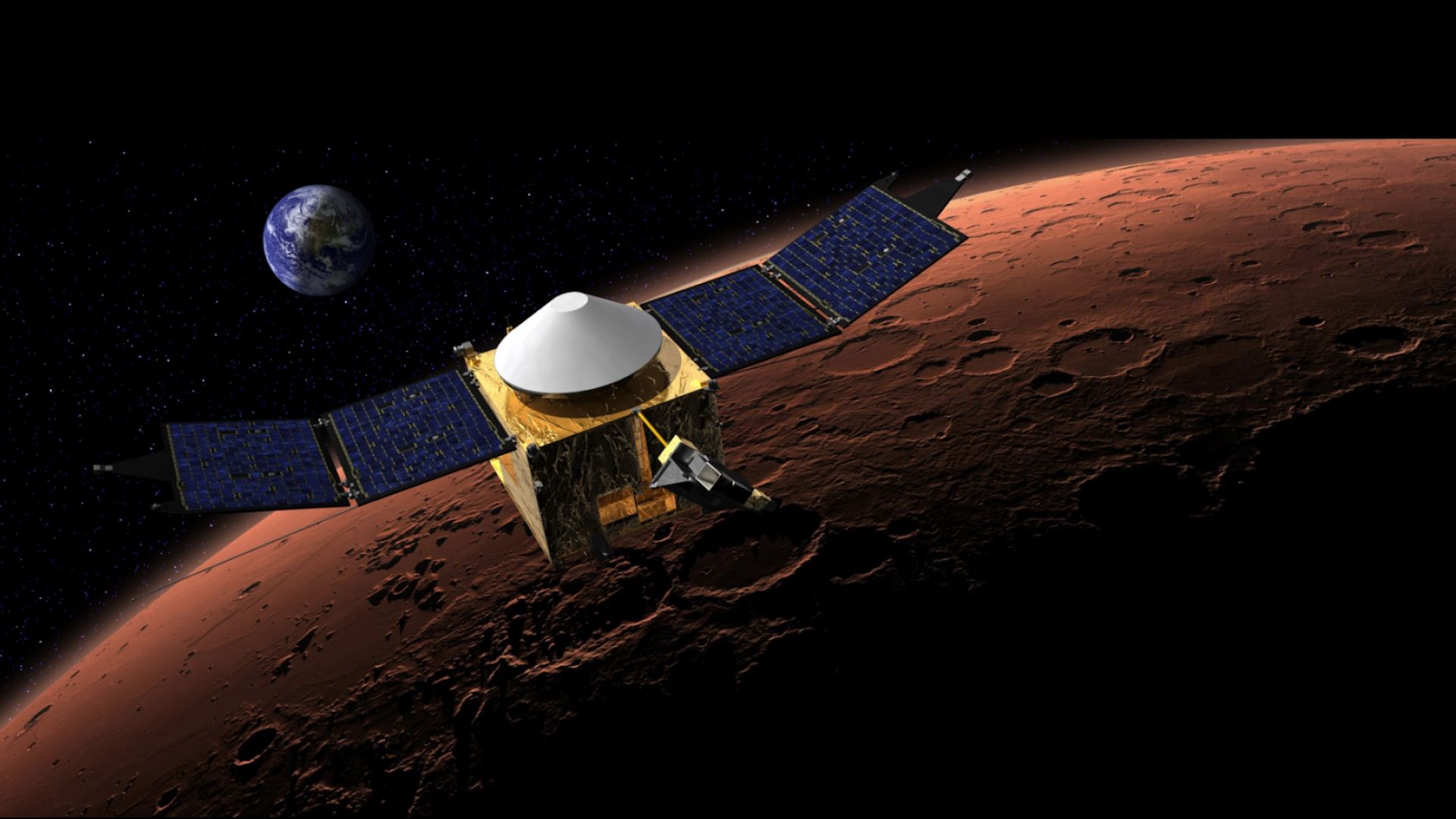
Summary: NASA's MAVEN orbiter, declared dead on June 3, will eventually crash into Mars. The surprise is how soon. Project Manager Mike Moreau disclosed on June 5 that the spacecraft's current orbit puts it on a 50- to 100-year decay timeline, regardless of the December 2025 anomaly that cut off contact. MAVEN served nearly 12 years studying how the solar wind strips away the Martian atmosphere — a question central to understanding how the planet lost its water.
A "Mars Morgue" in Orbit
Moreau's briefing was the most candid public accounting of MAVEN's state since the spacecraft fell silent. "The spacecraft is basically in a configuration, in an orbit, that's very similar to what it would have been if the mission had ended nominally," he said.
The team designed MAVEN to end its life in a "safe" parking orbit — high enough that the spacecraft would not threaten any future surface missions, but low enough that natural atmospheric drag would eventually drag it down. The original plan called for 50 to 100 years in that orbit, with the exact decay timeline set by the 11-year solar cycle. The solar cycle modulates how much the Martian upper atmosphere heats and expands, which in turn changes the drag at MAVEN's altitude.
That means MAVEN will join what space reporters are starting to call the "Mars morgue" — a growing collection of silent spacecraft, failed landers, and Soviet-era relics circling the Red Planet. The European Space Agency's Schiaparelli lander crashed in 2016; Russia's Mars 2 and Mars 3 landers have been silent on the surface since 1971. Multiple defunct Soviet orbiters remain in Mars orbit as well.
The Mission MAVEN Built
MAVEN — short for Mars Atmosphere and Volatile EvolutioN — launched in November 2013 and entered Mars orbit in September 2014. It was the first spacecraft designed specifically to study how the solar wind strips the Martian upper atmosphere, a process that almost certainly drove the planet's climate from warm and wet to cold and dry over billions of years.
The mission's defining instrument suite included a mass spectrometer, a solar-wind ion analyzer, and a remote-sensing ultraviolet spectrometer. MAVEN also performed multiple "deep-dip" campaigns, lowering its periapsis to within 130 kilometers of the surface to sample the ionosphere directly. By the time of contact loss, the spacecraft had long outlived its one-year primary mission and was operating on a reduced propellant budget that limited the number of deep-dips.
MAVEN also served as a communications relay for NASA's Curiosity and Perseverance rovers, passing surface data back to Earth during critical mission phases.
What Comes Next
With MAVEN gone, the count of active NASA orbiters at Mars drops from three to two: Mars Odyssey, which arrived in 2001, and the Mars Reconnaissance Orbiter, in orbit since 2005. Both are well past their design lifetimes and have not announced end-of-mission dates. The proposed Mars Ice Mapper mission has not yet been formally started.
ESA's Mars Express and ExoMars Trace Gas Orbiter continue to operate, as does China's Tianwen-1 orbiter. The Tianwen-1 orbiter, which arrived in 2021, has been conducting its own atmospheric and surface surveys and is the most recent addition to the active Mars fleet.