NASA's Neil Gehrels Swift Observatory Gets Critical Rescue Mission Update
Summary: NASA's Neil Gehrels Swift Observatory, launched in 2004, faces imminent orbital decay with reentry expected in late 2026. NASA's $30 million Link spacecraft by Katalyst Space Technologies passed key environmental testing on May 4, 2026, clearing the way for a planned 2026 launch to rescue the $500 million space telescope.
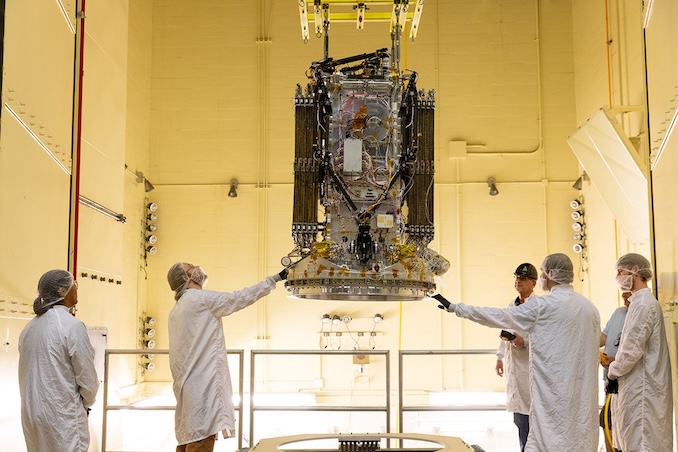
A mission to prevent NASA's $500 million Neil Gehrels Swift Observatory from a fiery reentry through Earth's atmosphere just passed a critical prelaunch testing milestone. On May 4, 2026, NASA's Link spacecraft — built by Katalyst Space Technologies — completed environmental testing at the agency's Goddard Space Flight Center in Greenbelt, Maryland, successfully firing its three ion thrusters, deploying one of its three arms, and experiencing space-like hot and cold temperatures inside the Space Environment Simulator.
The Swift Observatory, launched in 2004, lacks its own onboard propulsion system and would naturally decay in orbit over time. However, increased solar activity in recent years accelerated its orbital decay, dropping the spacecraft from approximately 600 km to 400 km altitude, with anticipated uncontrolled reentry in late 2026 without intervention.
"The Swift boost attempt is a fast, high-risk, high-reward mission," said John Van Eepoel, Swift's mission director at NASA Goddard. "Swift will likely re-enter the atmosphere sometime later this year if we don't attempt to lift it to a higher altitude. Katalyst has gotten to this point in just eight months, and we're glad they were able to use NASA's facilities to test Link and draw on our expertise to help tackle questions that popped up along the way."
NASA awarded Katalyst a $30 million contract in September 2025 to develop the Link spacecraft capable of docking with Swift and boosting its orbit. Katalyst selected Northrop Grumman's Pegasus XL air-launched rocket for the mission due to Swift's 20.6-degree orbital inclination.
"Given how quickly Swift's orbit is decaying, we are in a race against the clock," said Kieran Wilson, Link's principal investigator at Katalyst. "The clock is ticking on Swift's descent, so we have to find a balance between testing and problem solving that gives the mission the best chance of success."