
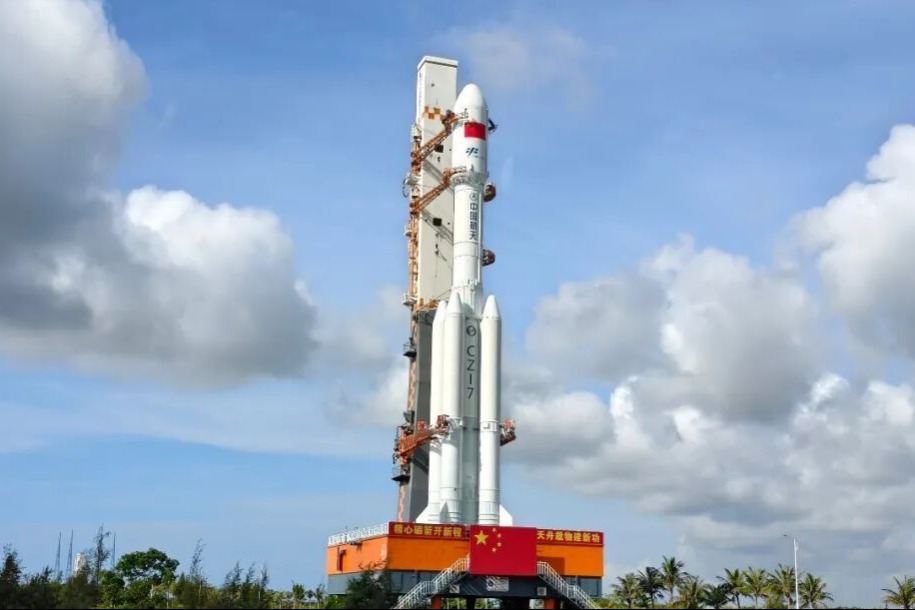
Tianzhou-10 Cargo Spacecraft Transferred to Launch Pad Ahead of Imminent Launch
Summary: China's Tianzhou-10 cargo spacecraft and Long March-7 Y11 carrier rocket combination was vertically transferred to the launch area at the Wenchang Spacecraft Launch Site in Hainan Province on May 8, marking the final stage before launch. The spacecraft will carry nearly 6.3 tonnes of supplies, including a third new-generation spacesuit, a new treadmill, and six scientific experiment payloads.
According to the China Manned Space Agency (CMSA), the Tianzhou-10 cargo spacecraft and Long March-7 Y11 carrier rocket combination was vertically transferred to the launch site at the Wenchang Spacecraft Launch Site on May 8, completing the transition from the technical area to the launch area. This marks the official start of final launch preparations.
The CMSA stated that all facilities and equipment at the launch site are in good condition, and follow-up work including pre-launch functional checks and joint tests will proceed as planned. The launch window will be selected in the coming days.
Tianzhou-9 undocked from the Tiangong space station combination on May 6 at 16:34 Beijing Time, transitioned to independent flight, and subsequently re-entered the atmosphere under controlled conditions, clearing the forward docking port for Tianzhou-10.
Tianzhou-10 is scheduled to deliver nearly 6.3 tonnes of supplies to the space station, covering 220+ items across the astronaut system, space station system, cargo spacecraft system, and space application system, plus approximately 700 kg of propellant. A third new-generation extravehicular spacesuit will be delivered on this mission, completing the full replacement of the station's spacesuit inventory alongside the two suits delivered by Tianzhou-9. The mission also carries a new treadmill and six scientific experiment payloads with a total mass of approximately 280 kg, covering microgravity fluid physics and space technology research — the highest number of experiment payloads delivered in a single cargo mission since the space station's construction began.