Near-Rectilinear Halo Orbit
Author: Tianjiang Says
Website: https://cislunarspace.cn
Definition
A Near-Rectilinear Halo Orbit (NRHO) is a sub-class of Halo orbits near the Earth-Moon collinear libration points or . In the synodic reference frame, when the out-of-plane amplitude of a Halo orbit is much larger than the in-plane amplitude , the orbit shape transitions from the classic "cashew-shaped" Halo orbit to an approximately linear reciprocating motion -- i.e., the NRHO. In other words, the NRHO corresponds to the extreme members of the Halo orbit family with large ratios.
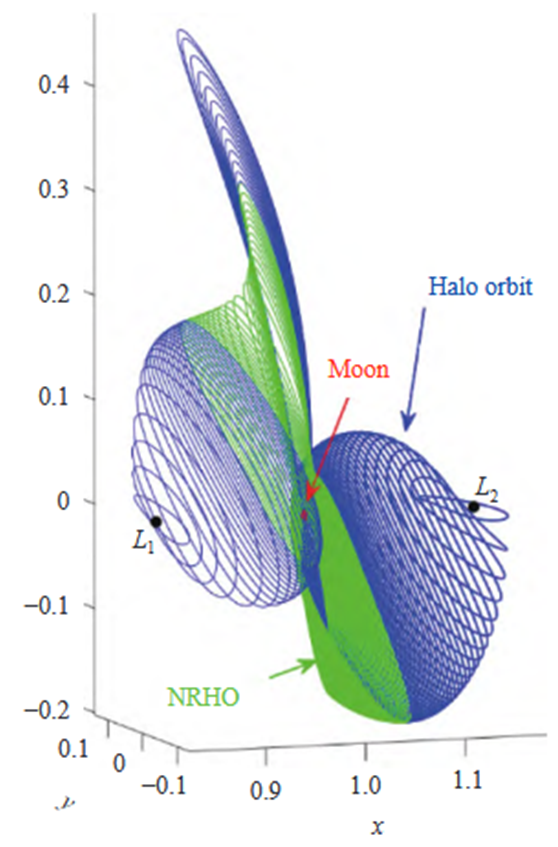 Earth-Moon L1 northern family and L2 southern family Halo orbits, with the extreme configuration being the NRHO
Geometric Characteristics
- Extremely low perilune altitude: typically below 100 km
- Apolune: located near the Earth-Moon point
- Orbital plane symmetric about the plane: with southern and northern families as two branches
- Overall presents an approximately linear reciprocating motion
Resonance Relationships
Similar to DROs, NRHOs also exhibit resonance relationships with the Moon's orbital period. When the orbital period and the Moon's orbital period satisfy , it is referred to as an synodic resonant NRHO.
| Resonance Ratio | Characteristics and Applications |
|---|---|
| 3:1, 4:1 (low-order) | Low perilune altitude, advantageous for lunar surface exploration and communications relay |
| 9:2 | NASA Gateway space station selected orbit -- good stability, suitable for long-term station-keeping |
| 11:2 (high-order) | Better orbital stability, suitable for long-duration mission |
Dynamic Symmetry
Unlike DROs which exhibit symmetry about the -axis, NRHOs display mirror symmetry about the plane. When an NRHO crosses the plane, the velocity components satisfy the conditions: and change sign while remains unchanged. This symmetry provides natural shooting conditions for differential correction: select an initial point on the plane, retaining only and as free variables, integrate for half a period, and verify the plane crossing conditions -- enabling iterative convergence to a periodic orbit.
Stability Characteristics
NRHO stability analysis requires attention to:
- Floquet multipliers: eigenvalues of the monodromy matrix characterizing the amplification/attenuation characteristics of orbital perturbations in each direction
- Perilune distance : excessively small may risk lunar surface impact, while excessively large weakens communications and exploration advantages
- Coupling with invariant manifolds in the libration point region: a unique dynamic characteristic distinguishing NRHOs from DROs
Engineering Applications
NRHOs have become a popular candidate orbit for current cislunar space missions:
- China's Chang'e-4 relay satellite "Queqiao": successfully operating in an Earth-Moon point Halo orbit, providing communications relay services for lunar far-side exploration
- NASA "Gateway" space station: planned deployment in the southern family 9:2 resonant NRHO
- Cislunar space situation awareness: NRHOs, with their unique orbital position, are well-suited for deploying relay communications and observation platforms
Application in A2PPO Low-Thrust Transfer Research
Ul Haq et al. (2026) used the A2PPO (Attention-Augmented Proximal Policy Optimization) algorithm to investigate autonomous low-thrust transfers from L₂ Halo orbit to NRHO (Scenario S2):
- Departure orbit: L₂ southern Halo orbit (, period 14.55 days)
- Target orbit: L₂ southern NRHO (, period 6.99 days)
- Transfer result: 8.38 days, consuming 5.00 kg of propellant
- Transfer characteristics: Forms a lunar flyby geometry
Transfers between NRHO and Halo orbits require significant energy change ( change of ~0.08) and represent a high-difficulty scenario in low-thrust trajectory optimization. A2PPO is capable of autonomously learning efficient transfer strategies without requiring an initial guess.
Related Concepts
- Distant Retrograde Orbit (DRO)
- Earth-Moon L1/L2 Halo Orbits (EML1/EML2 Halo)
- A2PPO (Attention-Augmented Proximal Policy Optimization)
- Starshade
- Birkhoff-Gustavson Normal Form
- Central Manifold
- Action-Angle Variables
- Orbit Identification
- Halo Orbit
- Circular Restricted Three-Body Problem (CR3BP)
- Libration Point (Lagrangian Point)
- Ephemeris Model
- Invariant Manifold
Core Elements
Orbit Definition
Near-Rectilinear Halo Orbit (NRHO) is an extreme sub-class of the Halo orbit family with large ratio. The orbit shape transitions from the classic "cashew" form to an approximately linear reciprocating motion. The perilune altitude is extremely low (typically < 100 km), and the apolune is located near the L₂ point.
Dynamic Characteristics
- Resonance relationships: NASA Gateway selected the 9:2 resonant NRHO, offering good stability for long-term station-keeping
- Symmetry: Mirror symmetry about the plane
- Stability: Characterized through Floquet multipliers analyzing perturbation amplification/attenuation in each direction
- Maintenance cost: Low (perilune distance requires precise control to balance exploration advantages against impact risk)
Design Methods
- Exploiting symmetry: Select initial points on the plane, retaining and as free variables
- Half-period integration: Verify plane crossing conditions, iterating to convergence on a periodic orbit
- Resonance ratio selection: Choose the appropriate resonance ratio based on mission requirements (e.g., 9:2, 11:2)
- Invariant manifold analysis: Design transfer orbits using invariant manifolds in the libration point region
Application Value
NRHO has become a popular candidate orbit for current cislunar space missions. NASA's Gateway space station is planned for deployment in the L₂ southern family 9:2 resonant NRHO. China's Chang'e-4 relay satellite "Queqiao" has successfully operated in an L₂ point Halo orbit, validating the application value of this orbit family for lunar far-side communications relay.
References
- Zimovan E M. Rectilinear halo orbits and their applications in cislunar space[D]. Purdue University, 2017.
- Williams J, Whitley R. Targeting cislunar rectilinear halo orbits for spacecraft missions[C]. 2017.
- Wu Weiren. Chang'e-4 Lunar Far-Side Soft Landing Mission Design[J]. 2017.
- Qiao C, Long X, Yang L, et al. Orbital parameter characterization and objects cataloging for Earth-Moon collinear libration points[J]. Chinese Journal of Aeronautics, 2025. doi: 10.1016/j.cja.2025.103869.