
JWST Weighs a 'Sleeping Giant' Black Hole 10 Billion Light-Years Away: 6 Billion Times the Sun's Mass
Summary: An international team of astronomers used the James Webb Space Telescope (JWST) to measure the mass of a dormant supermassive black hole roughly 10 billion light-years away by tracking the collective motion of stars in the host galaxy's core. The black hole weighs approximately 6 billion solar masses. This marks the first time the stellar dynamics technique has been successfully applied at such a distance — about 15 times farther than the previous record of 700 million light-years. The research was published in Science on June 4, 2026.
Key Findings
The dormant supermassive black hole sits at the heart of galaxy MRG-M0138. Because it is not actively accreting matter, it lacks a luminous active galactic nucleus (AGN) and is effectively invisible. Instead, the team used JWST to track the motions of stars in the galaxy's core — their velocities directly reflect the black hole's gravitational pull and hence its mass.
Key data points:
- Black hole mass: ~6 billion solar masses
- Distance: ~10 billion light-years (observed as it was when the universe was ~4 billion years old)
- Technique breakthrough: The previous farthest application of stellar dynamics was 700 million light-years; this extends it by roughly 15x
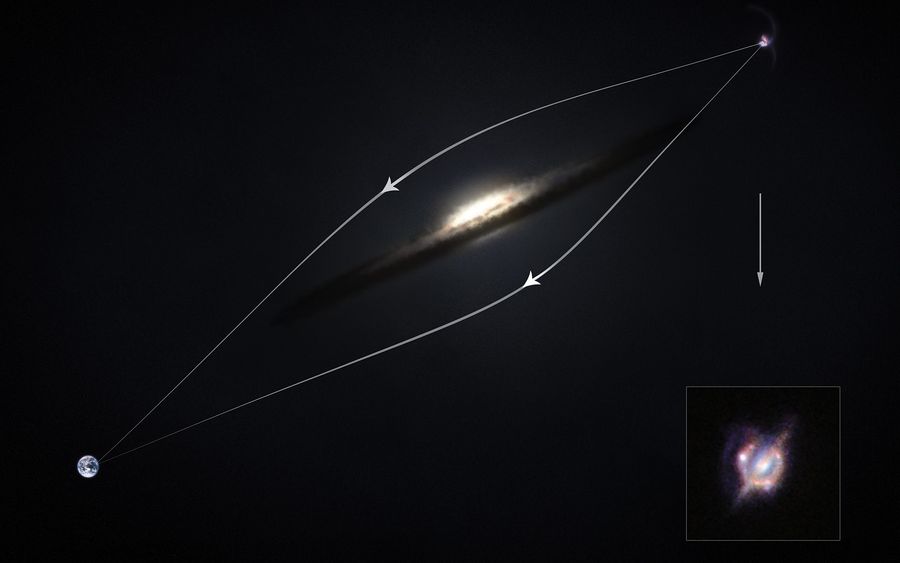
- Magnification: A foreground galaxy between MRG-M0138 and Earth provided gravitational lensing that magnified the target by ~30x
The Role of Gravitational Lensing
At such extreme distances, resolving individual stellar motions is virtually impossible without natural magnification. The team leveraged gravitational lensing — predicted by Einstein's general relativity — where a foreground galaxy bent and refocused light from MRG-M0138, amplifying it by a factor of 30. This allowed JWST to reconstruct the internal details of the distant galaxy and track stellar motions in its core.
Andrew Newman of Carnegie Science explained: "By combining JWST data with gravitational lensing, we could peer inside the black hole's sphere of influence, where its gravity boosts the speeds of stars. This is one of the best techniques we have to weigh a black hole, so we were excited to extend it to a much earlier period in cosmic history."
What "Dormant" Means
Both MRG-M0138 and its central black hole are currently dormant — the black hole is no longer actively feeding, and the galaxy is no longer forming new stars. The team proposes that the black hole underwent a ravenous feeding phase earlier in its history, during which it would have appeared as a blazing quasar. The energy released during that phase expelled gas and dust from both the black hole's vicinity and the galaxy itself, starving the galaxy of raw material for star formation.
Richard Ellis of University College London, the team leader, noted: "Determining how stars collectively move within the core of this distant galaxy has allowed us to measure the mass of its otherwise undetectable supermassive black hole. By demonstrating the feasibility of such a technique for galaxies in the early universe, we can now undertake a more complete census of how black holes develop over time and infer their role in shaping galaxy evolution."
Sources (original pages)
- space.com: James Webb Space Telescope weighs 'sleeping giant' black hole from 10 billion light-years away
- Research published in Science (June 4, 2026)