
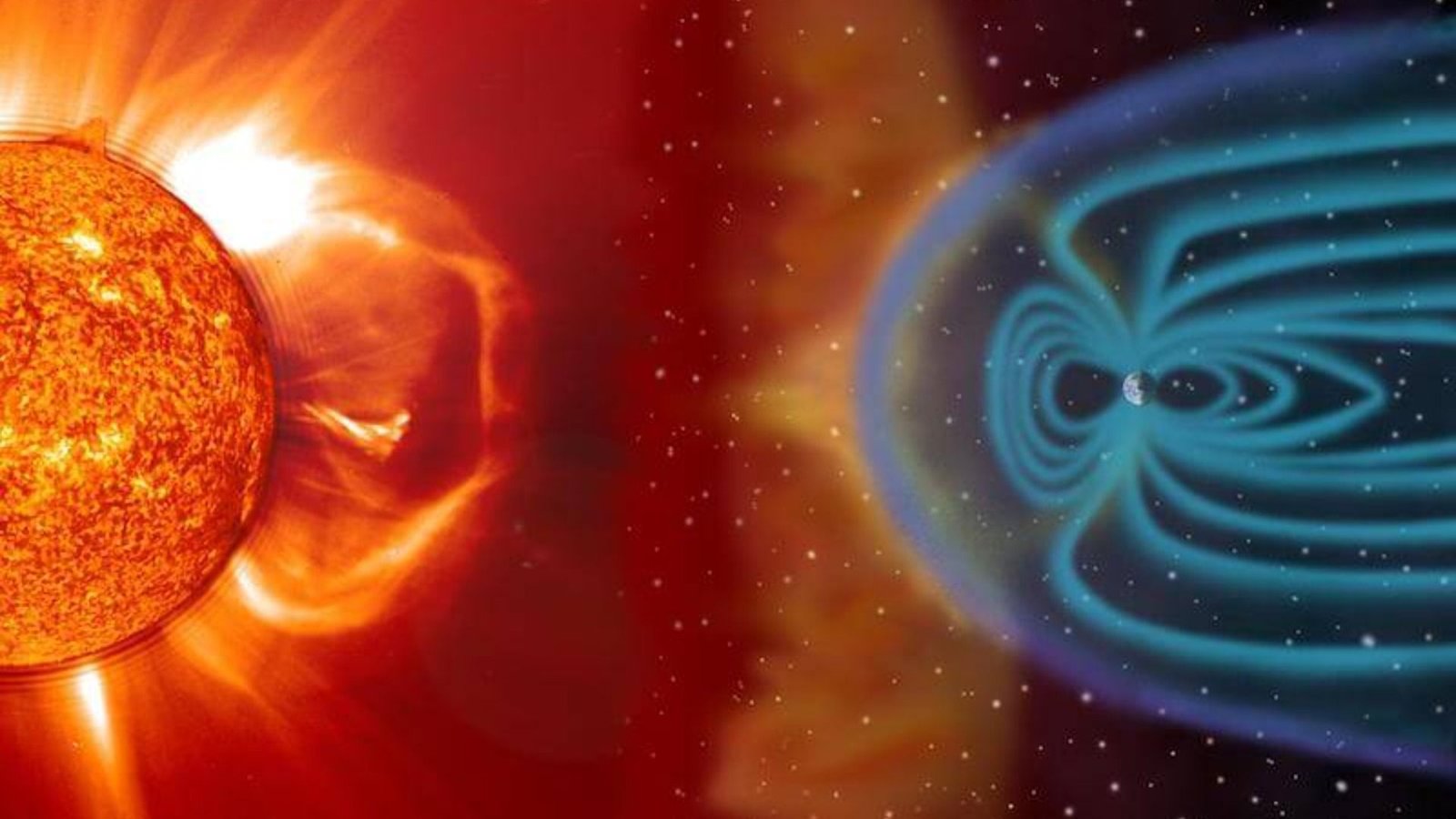
Boston University Team Proposes StormWall: Spacecraft Fleet to Reinforce Earth's Magnetosphere Against Solar Storms
Summary: A research team led by Brian Walsh of Boston University has proposed a planetary defense concept called StormWall — deploying six geosynchronous spacecraft carrying ionizable materials such as barium, lithium, sodium, and calcium. When released during an approaching solar storm, sunlight ionizes the vaporized particles into an artificial plasma cloud that thickens the magnetopause boundary, deflecting solar wind energy and reducing geomagnetic storm intensity by more than 50%. The study was published on June 2, 2026 in the journal Space Weather.
Concept
Earth's magnetic field forms the magnetosphere, a natural shield against the solar wind. However, during particularly powerful solar eruptions, the magnetic fields carried by the solar wind can align perfectly with Earth's own field, triggering a process called magnetic reconnection. This opens a channel through which massive amounts of solar energy pour into near-Earth space, causing geomagnetic storms.
StormWall's core idea is to actively thicken this boundary on the sunward side of the magnetopause. A fleet of six spacecraft would be stationed in geosynchronous orbit, each carrying stores of "mass-loading material" — substances like barium, lithium, sodium, or calcium that can be stored as a solid or liquid and vaporized on command. When a dangerous solar storm is detected heading toward Earth, ground controllers would command the fleet to release the material. Sunlight quickly ionizes the vaporized particles, transforming them into a cloud of electrically charged plasma.
This artificial plasma drifts toward the sun-facing edge of the magnetosphere, effectively increasing the mass density of the boundary layer. The added mass forces solar wind energy to scatter repeatedly within the plasma rather than penetrating directly, significantly reducing the intensity of the resulting geomagnetic storm.
"People have always thought, 'space is huge, the sun is massive, we just have to sit here and take whatever it gives us,'" Walsh said in a statement. "But what we found is that we can impact it."
Simulation Results
The team simulated the historic May 2024 geomagnetic storm, often called the Mother's Day storm, under two conditions: one recreating the event naturally, and a second with the StormWall plasma shield active. The results showed that while StormWall would not eliminate a geomagnetic storm entirely, it could reduce its intensity by more than 50%. By disrupting the flow of energy at the magnetosphere boundary, the artificial plasma essentially forces space weather to bounce around and past Earth.
Challenges and Outlook
The concept faces several practical constraints. The fleet would need to carry a payload equivalent to about a dozen oil trucks' worth of material — a significant expense. More critically, once the material is released and photoionized, the system becomes a "one-and-done" solution: the plasma is swept away by the solar wind within roughly six hours and cannot be replenished.
However, the researchers note that as private companies pour billions into orbital infrastructure — including concepts like space-based data centers — the financial case for proactive space weather defense could soon become viable. Walsh stated that "the amount of mass we need, the launch capacities — it's all within our capabilities."
The study acknowledges that modifying an interconnected system requires careful evaluation of unintended consequences, but assesses the long-term contamination risk as low because the artificial plasma would leave the magnetosphere relatively quickly rather than re-entering Earth's atmosphere.
Because the magnetosphere blankets the entire globe, StormWall would serve as a collective shield for all nations. "If you built it, if it was deployed, it would help all people on the planet," Walsh said. "You couldn't make it in a way that helped only one country, one group of satellites."