
Shenzhou-23 Crew Releases First In-Orbit Work Images; One Member to Attempt China's First Year-Long Space Station Stay
Summary: The China Manned Space Agency (CMSA) published the first batch of in-orbit work and life images from the Shenzhou-23 crew on June 7, 2026. Commander Zhu Yangzhu, pilot Zhang Zhiyuan, and payload specialist Lai Ka-ying have fully adapted to microgravity and are steadily advancing over 100 planned science experiments. One crew member will remain aboard the station across both the Shenzhou-23 and Shenzhou-24 missions, attempting China's first single-mission year-long space residency.
 Credit: China Manned Space Agency (CMSA)
Mission Background
Shenzhou-23 launched from the Jiuquan Satellite Launch Center on May 24, 2026, at 23:08 Beijing time atop a Long March 2F (Y23) rocket. The spacecraft docked with the radial port of the Tianhe core module on May 25 at 02:45 Beijing time, completing rendezvous and docking in approximately 3.5 hours. At 05:13 the same day, the Shenzhou-23 crew met the outgoing Shenzhou-21 crew in the eighth "space reunion" aboard the Chinese Space Station. After several days of joint operations and in-orbit handover, the Shenzhou-21 crew returned to Earth.
First In-Orbit Images
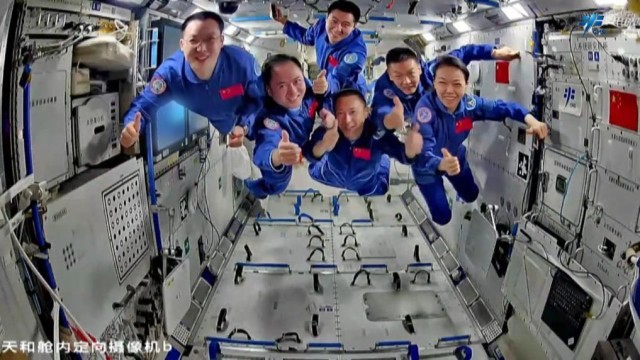
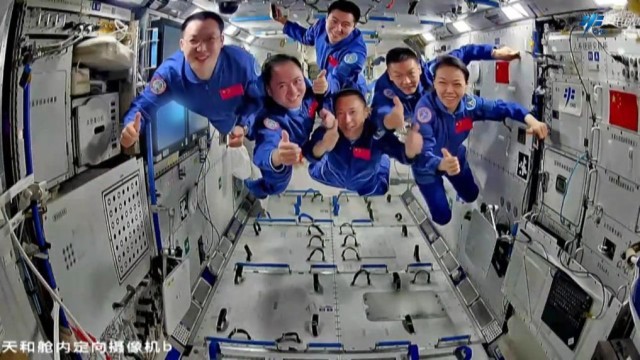
The images released on June 7 show the three astronauts conducting space science experiments, operating equipment, eating in microgravity, and relaxing inside the station. They also document the historic moment when all six astronauts — both the Shenzhou-23 and Shenzhou-21 crews — worked together inside the Tianhe core module during the handover period.
All three crew members appear to be in good physical condition and have fully adapted to the microgravity environment.
China's First Year-Long Residency Experiment
The most notable scientific objective of this mission is the plan for one crew member to span both the Shenzhou-23 and Shenzhou-24 missions, remaining aboard the station for approximately one year. This will be China's first single-mission year-long space residency test.
According to the May 23 pre-launch press conference, the core purposes of the year-long experiment include:
- Implementing China's first "Space Human Body Research Plan", collecting comprehensive physiological data under longer-duration flight conditions
- Verifying astronaut health protection capabilities for long-term flight, improving in-orbit medical monitoring and protection systems
Since Shenzhou-13, eight astronaut crews have completed six-month stays aboard the station, and some astronauts have accumulated close to a year of total in-orbit time across multiple missions. However, a single year-long mission represents an untested milestone for China's human spaceflight program.
Crew Composition
| Astronaut | Role | Background |
|---|---|---|
| Zhu Yangzhu | Commander / Flight Engineer | Previous in-orbit experience |
| Zhang Zhiyuan | Pilot | Military pilot background |
| Lai Ka-ying | Payload Specialist | Hong Kong's first astronaut; former HK police officer |
Lai Ka-ying's selection marks the first time an astronaut from the Hong Kong Special Administrative Region has been admitted into China's human spaceflight program.
Science Program
The Shenzhou-23 mission includes over 100 planned science and technology experiments across several frontier fields:
- Space life sciences: Zebrafish embryos, mouse embryos, and stem-cell "artificial embryos" for space embryology research
- Space materials science
- Microgravity fluid physics
- Aerospace medicine
- New aerospace technologies: In-orbit verification of new-type space energy storage batteries
Upcoming EVA
According to Chinese media reports, the Shenzhou-23 crew is expected to perform an extravehicular activity (EVA) in the coming weeks after completing the current phase of science experiments.