JWST Detects Methane on Interstellar Comet 3I/ATLAS for the First Time
Summary: A study published June 5 in The Astrophysical Journal Letters reports that the James Webb Space Telescope (JWST) Mid-Infrared Instrument (MIRI) detected methane outgassing from 3I/ATLAS on December 15–16, 2025 — the first confirmed detection of methane on any interstellar object. The signal appeared only after the comet's October 29, 2025 perihelion, and its delayed release tracks a parallel surge in carbon monoxide. MIRI simultaneously measured water vapor, carbon dioxide, and nickel vapor; the relative abundances of CO2 and CH4 against water are several times higher than is typical for solar-system comets, suggesting 3I/ATLAS condensed in a colder, chemically distinct protoplanetary disk — possibly one that existed 11–12 billion years ago.
3I/ATLAS was confirmed in July 2025 with a hyperbolic orbit (eccentricity ≈ 6.14) that places it firmly outside the solar system. It is the third known interstellar visitor after 1I/ʻOumuamua (2017) and 2I/Borisov (2019). The SETI Institute's June 4 Allen Telescope Array narrowband radio search of 3I/ATLAS turned up no technosignatures; the June 5 JWST chemical result, reported in the same week, asks a completely independent question: what kind of low-temperature protoplanetary disk did this object condense in, and what thermal history drove its present outgassing?
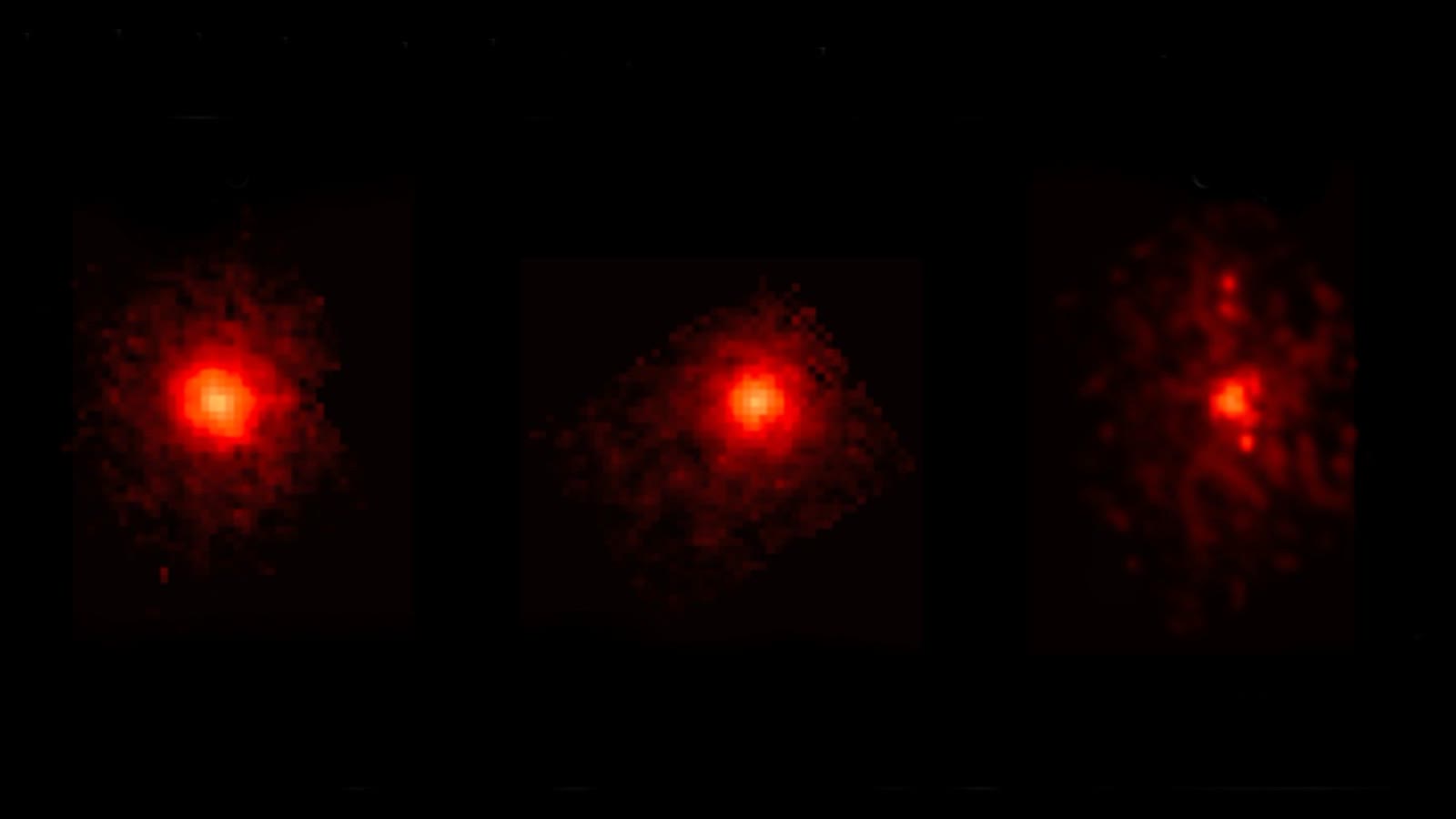
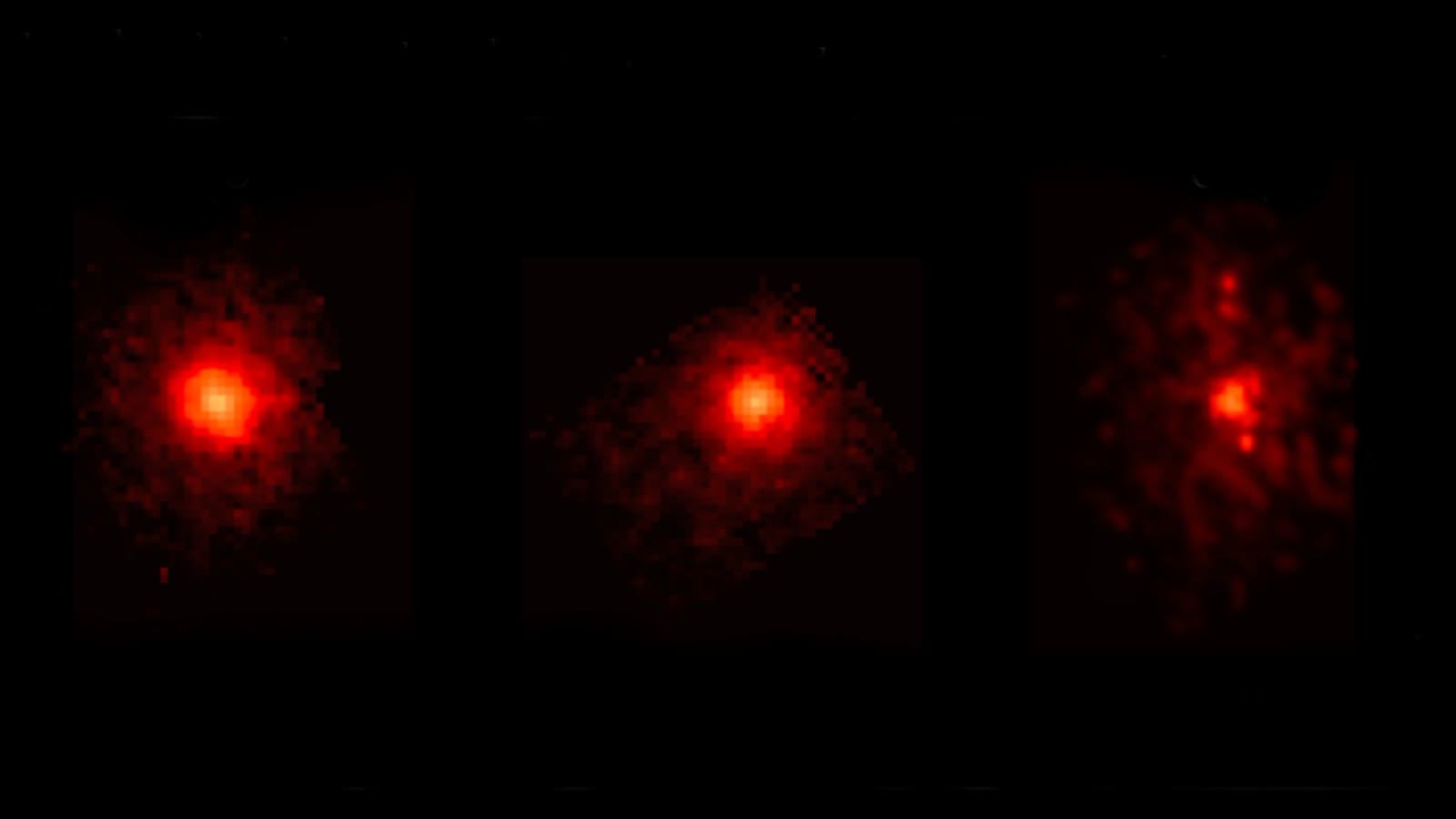
MIRI first turned toward 3I/ATLAS on December 15–16, 2025, about 47 days after perihelion and 2.20 AU (330 million km) from the Sun. The comet was in a particularly active phase following the post-perihelion heat pulse. Matthew Belyakov of Caltech, the paper's lead author, and his collaborators noted that as 3I/ATLAS approached the water-ice line (~2.5 AU), water production from the coldest regions of the surface and coma was beginning to shut down. Water vapor was, however, still being released at large distances from the nucleus as icy grains in the coma sublimated — a process JWST has documented in solar-system comets.
The headline finding, though, is methane. Not a rare molecule in the solar system — methane is routinely seen in solar-system comets — but never previously confirmed on either 1I/ʻOumuamua or 2I/Borisov. 3I/ATLAS is the first interstellar object on which methane has been unambiguously detected, and the signal became appreciable only after perihelion. The authors attribute the delay to depth: methane is buried deeper in the cometary nucleus, and the additional solar heating after perihelion took time to reach those depths and sublimate the methane. The methane release pattern tracks a parallel 40-fold increase in CO relative to CO2 observed in December, consistent with both gases originating in deeper layers.
The same JWST observations returned relative abundances that look unusual by solar-system standards. The CH4-to-water and CO2-to-water ratios are both elevated, and the team notes that what looks anomalous in the solar system may be perfectly ordinary for the stellar system in which 3I/ATLAS formed — possibly as long ago as 11–12 billion years. The implication is that 3I/ATLAS condensed in a cold, CO2- and water-ice-dominated protoplanetary disk whose chemistry was distinct from the solar nebula. This reading is consistent with the chemistry implied by Tianwen-1's HIRIC dust observations of 3I/ATLAS from Mars orbit in May, which likewise pointed to a non-solar formation environment.
MIRI also confirmed a more exotic species: nickel vapor. Nickel atoms had been reported in 3I/ATLAS's coma soon after discovery, and the new mid-infrared detection independently confirms the signal — the nickel release mechanism persists in 3I/ATLAS's current activity phase.
Read against the year-long observational arc of 3I/ATLAS, the methane result closes a chapter that opened with the Vera C. Rubin Observatory archival precovery (data taken June 21 to July 2, 2025, predating the official July discovery by more than a week), then moved through Tianwen-1's dust observations from Mars orbit in May, the SETI Institute's negative technosignature result on June 4, and now the JWST chemical fingerprint on June 5. Each angle — dust, precovery, radio, mid-infrared chemistry — adds a different kind of data to the same interstellar visitor's portrait.
The delayed release of methane, the parallel CO surge, the elevated CO2 and CH4 abundance ratios, and the persistence of nickel vapor together separate 3I/ATLAS from solar-system comets and provide a concrete reference point for what cometary chemistry can look like in the cold, ancient protoplanetary disks of stars that lived and died long before the Sun.
Sources (original pages)
- Interstellar comet 3I/ATLAS is blasting out a bunch of methane. Here's why that's weird (Space.com, June 5, 2026)
- Tianwen-1 HIRIC observation of 3I/ATLAS dust activity (cislunarspace, May 20, 2026)
- 3I/ATLAS is not an alien spacecraft: SETI technosignature search comes up empty (cislunarspace, June 4, 2026)