LIGO/Virgo/KAGRA Release GWTC-5 Catalog: 161 New Black Hole Merger Signals, Clearest Verification Yet of Hawking's Area Theorem
Summary: On 26 May 2026, the LIGO-Virgo-KAGRA (LVK) Collaboration released the Gravitational-Wave Transient Catalog 5.0 (GWTC-5) online, adding 161 new gravitational-wave signals — all from black hole mergers — detected between 10 April 2024 and the end of January 2025. With the new release, the total catalog of confirmed gravitational-wave events has doubled to 390. The accompanying papers report three landmark results: the most precisely localized gravitational-wave source ever recorded (GW240615, locked to a 6-square-degree sky region), the clearest gravitational-wave signal ever observed (GW250114, signal-to-noise ratio 76.9), and the most stringent verification to date of Stephen Hawking's 1971 black hole area theorem at 99.999% confidence. The papers have been submitted to The Astrophysical Journal and The Astrophysical Journal Letters.
Catalog Composition and Detector Network Upgrades
GWTC-5 covers the period from 10 April 2024 through the end of January 2025. The defining feature of this observation run (O4) is that the Virgo detector — after a major upgrade — returned to the joint observing network, joining the two LIGO interferometers in Hanford and Livingston. For the first time since O3, all three flagship interferometers contributed simultaneously to a sustained observation run, which dramatically improved both the network's effective reach and the sky-localization precision of detected events.
The headline result of the localization improvements is GW240615 (15 June 2024), the merger of a 26-solar-mass and a 30-solar-mass black hole. The three-detector network pinned its sky position to a region of just 6 square degrees — the most precise localization of any gravitational-wave event to date, and the first to fit inside a sky patch roughly 1,000 times smaller than the apparent area of the full moon. The source lies about 3 billion light-years away. Crucially, the narrow sky region now makes it feasible to identify the host galaxy of a gravitational-wave source in routine electromagnetic follow-up — something that was technically possible for the brightest neutron-star mergers (e.g. GW170817) but had remained out of reach for the typical black hole merger until the Virgo upgrade.
The Clearest Signal and the Empirical Test of Hawking's Area Theorem
Among the new events, GW250114 (14 January 2025) stands out as the clearest gravitational-wave signal ever recorded, with a signal-to-noise ratio of 76.9. The event was produced by the merger of a 32-solar-mass and a 34-solar-mass black hole roughly 1.3 billion light-years away. The signal's waveform matches the general-relativistic prediction for a binary-black-hole merger essentially to the limits of detector sensitivity, with no detectable deviation from the template.
The LVK team used GW250114 to perform the most stringent test yet of Stephen Hawking's 1971 black hole area theorem, which states that the total area of the event horizon of a newly formed black hole cannot be smaller than the combined horizon areas of the two progenitor black holes. The numbers are striking: the two progenitor black holes had a combined horizon area of about 240,000 km²; the remnant black hole's horizon area is about 400,000 km². The LVK team reported that the comparison excludes violations of the area theorem at a confidence of 99.999% — a factor of roughly 30 improvement over the previous best test using GW150914 (the first direct gravitational-wave detection in 2015). More broadly, this is one of the cleanest experimental confirmations of general relativity in the strong-field regime: when two ultra-relativistic compact objects collide, the resulting black hole's horizon properties agree with the prediction of general relativity and Hawking's theorem to extremely high precision.
Second-Generation Black Holes and New Host Galaxies
GWTC-5 also provides some of the first clear evidence for "second-generation" black holes — black holes that themselves were formed from earlier mergers, and that have now merged again. Two events in particular, GW241011 (11 October 2024) and GW241110 (11 November 2024), show characteristic signatures of hierarchical mergers: the more massive member of each pair has spin and mass properties that are inconsistent with formation from the collapse of an isolated massive star, but are consistent with the products of an earlier black-hole merger. The LVK team interprets these as evidence that the two events occurred in densely packed stellar environments — likely the dense cores of massive star clusters.
With the improved localizations, the LVK team is now beginning to associate gravitational-wave sources with specific host galaxies for the first time at scale. This unlocks a powerful cosmological application: gravitational-wave sources can be used as "standard sirens" — the gravitational-wave signal itself encodes the distance to the source, while the host galaxy's measured redshift provides the recession velocity. Using GWTC-5's larger sample, the LVK team has measured the Hubble constant with a precision roughly 25% better than previous gravitational-wave-only measurements, providing a new and completely independent data point in the long-running "Hubble tension" debate.
Implications and Outlook
The GWTC-5 release marks a transition point for gravitational-wave astronomy. With 390 events now in the catalog, statistical population studies of black hole masses, spins, and merger rates are becoming precise enough to discriminate between competing formation channels (isolated binary evolution, dynamical formation in dense clusters, hierarchical mergers, primordial black holes). The improvements in localization, signal clarity, and host-galaxy identification open a path toward precision cosmology with standard sirens.
China's gravitational-wave community is engaged with LVK through several channels, including the Tsinghua LIGO Scientific Collaboration group, the Beijing Normal University gravitational-wave astronomy team, and the Sun Yat-sen University TianQin project for space-based gravitational-wave detection at lower frequencies (the milli-Hz band). The GWTC-5 algorithms, waveform templates, and statistical methods provide direct technical foundations for these next-generation detectors.
Sources (original pages)
- Guangming Online — Gravitational wave catalog expands; three major results uncover the mysteries of black holes (Liu Xia, 29 May 2026, in Chinese)
- space.com — Astronomers discover a 'lost world' of black hole mergers (Robert Lea, 1 June 2026)
- LIGO/Virgo/KAGRA Collaboration — GWTC-5.0 catalog release and data access (26 May 2026)
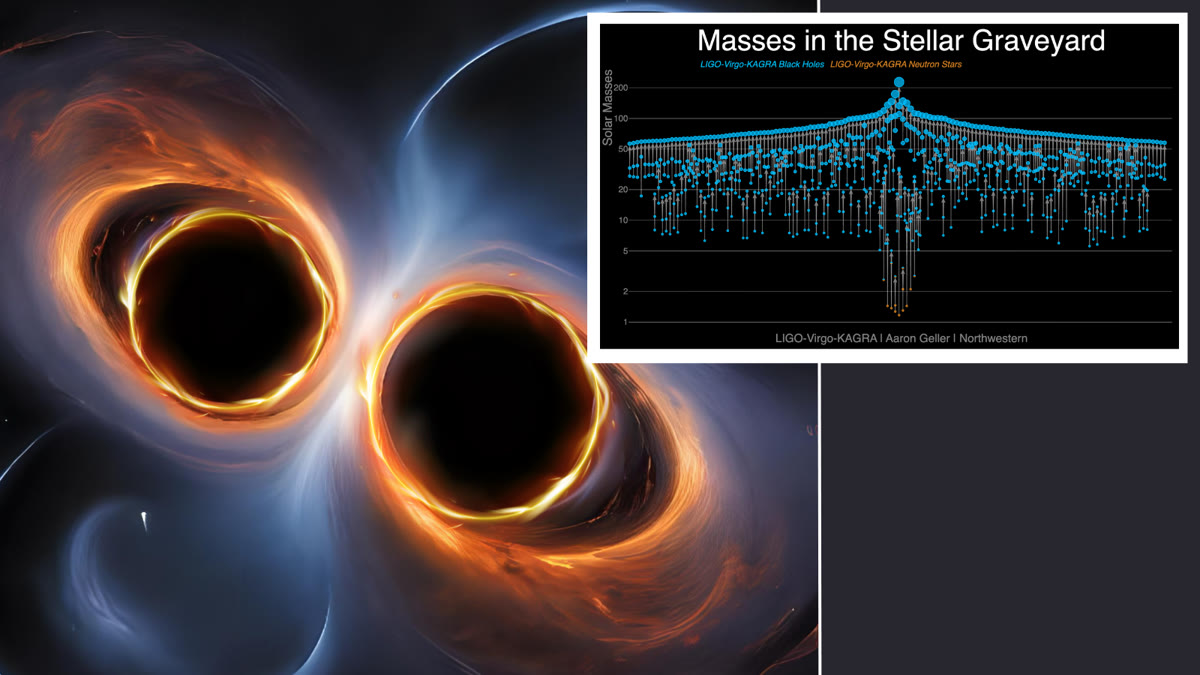
Image credit: Main figure is a numerical-relativity simulation of two merging black holes (background) overlaid with the LIGO-Virgo-KAGRA "Stellar Graveyard" mass distribution (inset); credit LIGO-Virgo-KAGRA / Aaron Geller (Northwestern). Image composition from the space.com report on GWTC-5.