
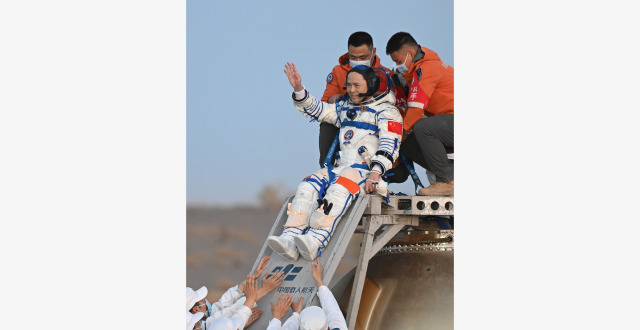
Shenzhou-22 Return Capsule Lands Safely, Shenzhou-21 Crew Returns After 7 Months in Space
Summary: At 20:11 BJT (12:11 UTC) on May 29, 2026, the Shenzhou-22 return capsule touched down successfully at the Dongfeng landing site in Inner Mongolia, safely returning the Shenzhou-21 crew — Commander Zhang Lu, Flight Engineer Wu Fei, and Payload Specialist Zhang Hongzhang — after nearly 7 months aboard China's Tiangong Space Station. The crew completed China's second-ever three-orbit rapid return, a milestone for the nation's crewed spaceflight program.
The Return
At 19:20 BJT (11:20 UTC), the Beijing Aerospace Flight Control Center issued the return command to the Shenzhou-22 spacecraft. The orbital module successfully separated from the return capsule, followed by the return propulsion system's engine ignition to begin the de-orbit burn. The service module then separated from the return capsule, leaving it to re-enter the atmosphere alone.
During re-entry, the capsule passed through the "blackout zone" — the period of communications loss as superheated plasma surrounds the vehicle. At approximately 10 km altitude, the parachute sequence initiated: drag chute first, then the main canopy deployed, dramatically slowing the capsule's descent. The return capsule, gently guided by its main parachute, touched down precisely at the Dongfeng landing site.
Search and rescue teams reached the capsule immediately upon landing. Medical personnel confirmed all three astronauts — Commander Zhang Lu, Flight Engineer Wu Fei, and Payload Specialist Zhang Hongzhang — were in good health, with the crew reporting they felt fine.
Three-Orbit Rapid Return
This mission featured China's second-ever three-orbit rapid return profile, reducing the number of orbits from the traditional five to just three before re-entry. This significantly shortens the total time from space station departure to ground touchdown. The successful application of this technique marks China's entry into a new phase of operational rapid return capability for crewed missions.
210 Days: Longest Single-Crew Duration in Chinese Spaceflight History
The Shenzhou-21 crew docked with the Tiangong Space Station's Tianhe core module on November 1, 2025, and returned to Earth aboard Shenzhou-22 on May 29, 2026, achieving a total on-orbit duration of 210 days. This sets a new record for the longest single-crew mission in Chinese spaceflight history, surpassing the previous mark held by the Shenzhou-15 crew.
Upon completion of this mission, Commander Zhang Lu became the second Chinese astronaut to accumulate over 400 days of total time in orbit, and currently holds the record for the most spacewalks performed by any Chinese astronaut. Flight Engineer Wu Fei and Payload Specialist Zhang Hongzhang both completed their maiden spaceflights.
During their mission, the crew conducted three spacewalks, performed inspections and photography of the Shenzhou-20 return capsule's porthole, and installed space debris protection devices on the space station. They also coordinated multiple cargo transshipment missions with Tianzhou cargo spacecraft. Working alongside ground research teams, the crew carried out extensive scientific experiments spanning microgravity fundamental physics, space materials science, space life science, aerospace medicine, and aerospace technology.
The crew also witnessed and participated in several historic firsts in China's crewed spaceflight program: the first return delayed due to a space debris strike on the Shenzhou-20 spacecraft, the first crew rotation involving a different return vehicle (Shenzhou-22 rather than their original Shenzhou-21 spacecraft), and the first emergency launch response operation — a coordinated ground-space emergency action across the entire Chinese space program.
On May 28, one day before their return, the Shenzhou-21 and Shenzhou-23 crews held a formal handover ceremony in Tianhe core module, during which Commander Zhang Lu transferred the symbolic key to the space station to Shenzhou-23 Commander Zhu Yangzhu.
The Shenzhou-22 return capsule will now undergo post-flight data download and technical inspection, providing valuable lessons for future crewed missions.