
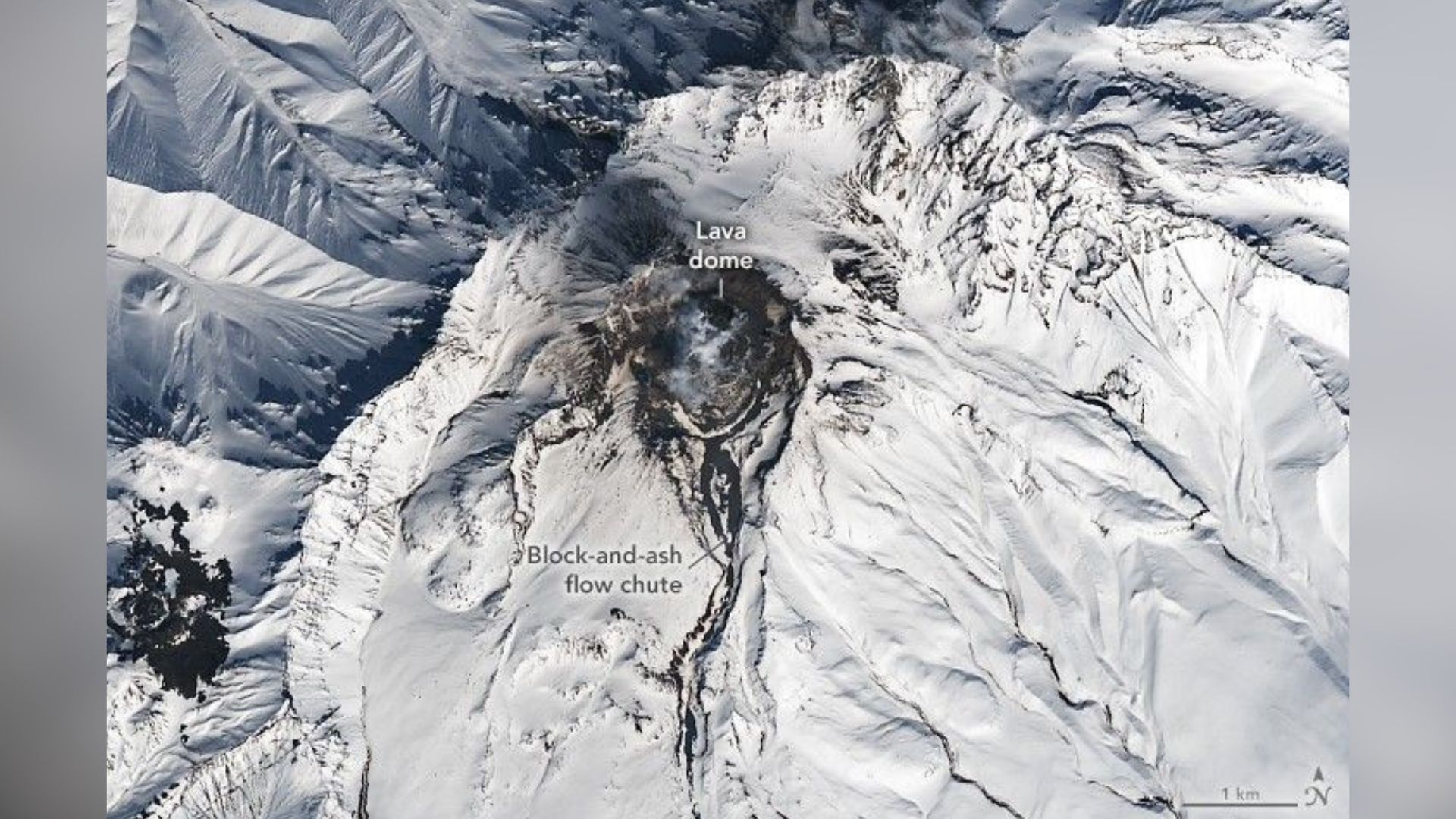
Satellites Spy Russia's Most Active Volcano Melting Snow From the Inside Out
Summary: Fresh Landsat 9 satellite images reveal volcanic heat melting snow from the inside out around Russia's Shiveluch volcano on the Kamchatka Peninsula, with dark channels of ash and debris cutting through snowy slopes.
Observation Data
According to images released by NASA's Earth Observatory on May 11, 2026, the Landsat 9 satellite captured detailed imagery of the Shiveluch volcano caldera on April 23, 2026: a growing lava dome is clearly visible, with dark channels of volcanic ash and debris flows cutting through the snow-covered slopes toward the volcano's peak.
Shiveluch, located on Russia's far-eastern Kamchatka Peninsula, is the northernmost active volcano on the peninsula and one of the most active volcanoes on Earth. NASA Earth Observatory data shows the volcano maintains near-constant activity, with satellites frequently detecting ash deposits, thermal anomalies, and avalanche events.
Scientific Significance
The observations reveal a unique mechanism of volcanic activity impacting high-latitude snow landscapes: heat from the magma chamber seeps upward through the caldera and fissure systems, forming melt channels within the snowpack rather than simply melting from the surface. This "melting from the inside out" process is relatively common in volcanoes with intense hydrothermal activity, but the high-resolution satellite images provide the clearest observational evidence to date.
Volcanology researchers indicate that the continuously growing lava dome is the core indicator of Shiveluch's current active status. Dome growth means new magma is continuously涌入 the volcanic system, and surface deformation and thermal anomaly signals will continue.