
Tiankong Constellation Officially Launched: China's First 220-Satellite Infrared Constellation Plan Unveiled
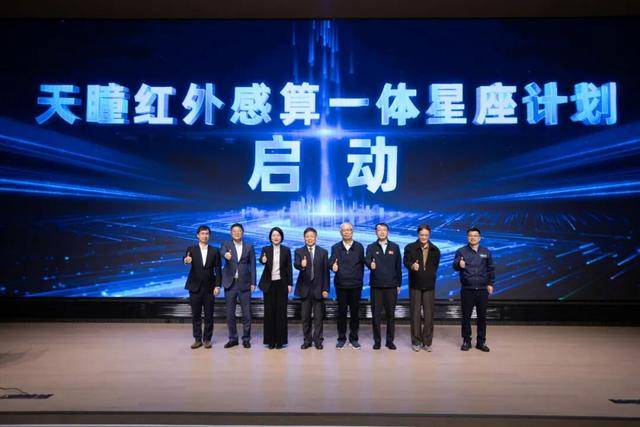
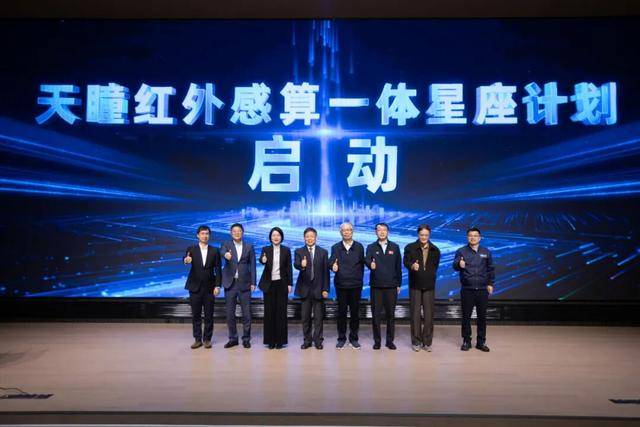
Summary: On April 22, the first Tiankong Infrared Satellite Industry Conference was held at the China Commercial Rocket Headquarters Park in Shanghai's Minhang District. At the event, Weixing Technology officially announced the launch of the Tiankong Constellation — China's first commercial infrared satellite constellation planned with 220 satellites. Featuring a sensing-computing integrated design with proprietary advanced infrared payload technology, the constellation will enable second-level target identification and minute-level early warning. The first batch of 10 satellites is planned for launch by the end of 2026, with full constellation completion targeted for 2030.
 Credit: The Paper
At the conference, Weixing Technology also formally settled into the China Commercial Rocket Headquarters Park and simultaneously released the "Space-Based Brain" product system, comprising three products — "Xinghuo" (Forest Fire), "Xingjian" (Overseas Asset Inspection), and "Xingjing" (Water Environment) — targeting forest fire prevention, overseas asset intelligence, and water environment governance respectively.
Sensing-Computing Integration: A New Paradigm for Infrared Satellites
The core technical innovation of the Tiankong Constellation lies in its "sensing-computing integrated" design — achieving deep integration of infrared detection and onboard real-time data processing directly on the satellite. As China's first commercial space company to deploy uncooled infrared detectors on satellites, Weixing Technology has broken through multiple key technologies for uncooled infrared detection in-orbit applications. Through proprietary algorithmic models that mitigate noise interference, the company has effectively improved signal-to-noise ratio and detection capability while maintaining low cost.
"We are in the commercial space business, so we have to solve the cost problem," explained Wan Lintao, Chief Data Officer at Weixing Technology. The team "figured out the in-orbit operating characteristics of uncooled infrared detectors" and combined them with self-developed algorithms to achieve commercially viable detection performance at low cost. The company is also exploring the use of carbon fiber to replace more satellite structural components, further reducing satellite weight and launch costs.
Application Scenarios: Second-Level Forest Fire Identification
Taking forest fire monitoring as an example, traditional satellites often cannot detect fires until they have spread to a large scale. The Tiankong Constellation, through coordinated data from both high and low Earth orbit infrared satellites, achieves full-chain processing of "scanning, imaging, and identifying" simultaneously. It can precisely detect small fires as small as 10 meters, supporting the entire process from pre-disaster early warning and mid-disaster analysis to post-disaster assessment, with monitoring frequency up to every 15 minutes.
Constellation Roadmap: First Launch End of 2026, Completion by 2030
Weixing Technology expects to launch the first batch of 10 satellites by the end of this year, aiming to complete the first phase of 28 satellites within 1-2 years, and the full constellation of over 220 satellites during the "15th Five-Year Plan" period (2026-2030). Once completed, the Tiankong Constellation will provide global high-frequency infrared monitoring capabilities, offering high-temporal-resolution, low-cost infrared observation data services for emergency disaster prevention, ecological environment protection, and marine monitoring.
Space-Based Brain Product System Released
The "Space-Based Brain" product system released at the conference is an intelligent application platform built on Tiankong Constellation data:
- Xinghuo (Star Fire): Focused on forest and grassland fire prevention, providing real-time fire point monitoring and early warning
- Xingjian (Star Inspection): Addressing overseas asset inventory needs, offering intelligent monitoring services based on infrared remote sensing
- Xingjing (Star Mirror): Dedicated to water environment governance, conducting water pollution and ecological change monitoring
Weixing Technology is one of China's first commercial space enterprises. It is led by CAS Academician Wang Jianyu as Chairman of the Technical Committee, and Shen Xuemin, former Director of the Chinese Academy of Sciences' Shanghai Micro-Satellite Engineering Center, as Chairman and Chief Technology Officer. The company has already successfully launched infrared satellites such as "Xinghuankun" (Star Ring), accumulating mature experience in commercial infrared satellite development and operations.