
Author: CislunarSpace
Source: https://cislunarspace.cn
DRO Family Classification
L1 DRO vs L2 DRO
The DRO family can be divided into two categories based on the libration point they orbit:
L1 DRO: The orbit center is near the L1 point, with an x-coordinate in the rotating frame of approximately (dimensionless). L1 DROs typically have smaller orbital radii, ranging from about 0.5 to 0.8 times the Earth-Moon distance from the Earth-Moon barycenter.
L2 DRO: The orbit center is near the L2 point, with an x-coordinate of approximately . L2 DROs generally have larger orbital radii, ranging from 0.8 to 2.0 times the Earth-Moon distance.
| Property | L1 DRO | L2 DRO |
|---|---|---|
| Libration point position (dimensionless x) | ||
| Orbital radius range | 0.5-0.8 Earth-Moon distances | 0.8-2.0 Earth-Moon distances |
| Typical period | 8-15 days | 12-25 days |
| One-way Earth communication delay | ~1.0 s | ~1.5-2.0 s |
| Lunar farside coverage | Poor | Poor |
Period and Amplitude
There is a one-to-one correspondence between DRO period and the Jacobi constant . Typical DRO parameters:
| Parameter | L1 DRO | L2 DRO |
|---|---|---|
| Period range | 8-15 days | 12-25 days |
| Semi-major axis | 20,000-50,000 km | 50,000-100,000 km |
| Amplitude | 5,000-20,000 km | 10,000-40,000 km |
| Jacobi constant | 3.03-3.08 | 3.00-3.06 |
The relationship between period and can be approximated as , where is the critical Jacobi constant for the existence of the DRO family in the CR3BP.
Bifurcation Diagram
There exists a rich bifurcation relationship between DROs and L1/L2 Lyapunov periodic orbits. Specifically:
- When gradually increases from low values, DRO orbits progressively "shrink" and eventually merge with L1/L2 Lyapunov orbits at the bifurcation point
- Conversely, when decreases from high values, Lyapunov orbits transform into DROs through bifurcation
This bifurcation relationship can be identified through changes in Floquet multipliers: when Floquet multipliers cross the unit circle () as real numbers, a bifurcation occurs.
On the bifurcation diagram, L1 DRO ↔ L1 Lyapunov ↔ L2 Lyapunov ↔ L2 DRO form a continuous energy evolution chain.
North-South Symmetry
The rotating frame of the CR3BP possesses reflection symmetry about the - plane ( leaves the equations of motion unchanged). This symmetry divides the DRO family into Northern and Southern families, which are mirror images of each other.
For a given L1/L2 DRO, its northern and southern families share identical dynamical properties (period, , Floquet multipliers), but differ in their spatial orientation. Mission design can select the northern or southern family based on lighting conditions (solar angle) and communication geometry.
Orbit Family Illustration
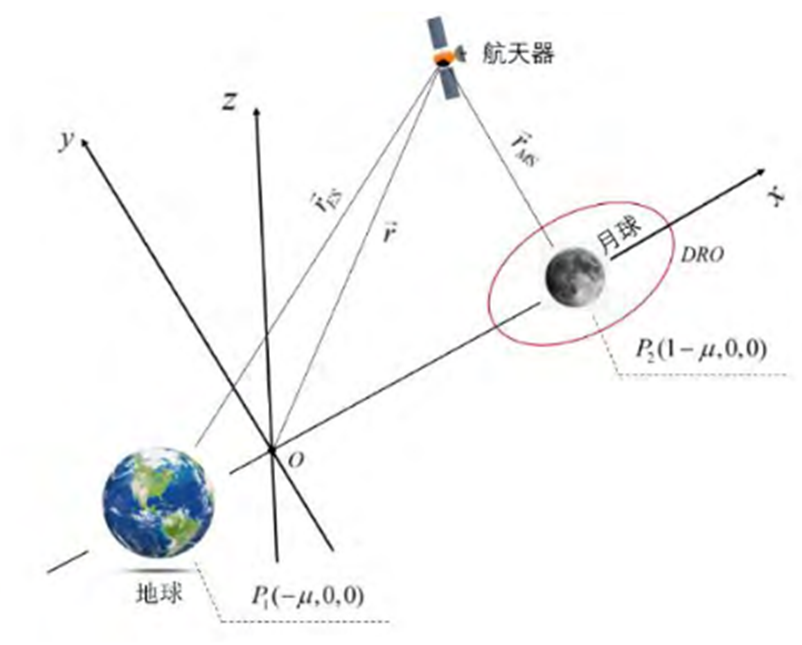
The figure above shows the morphology of DRO orbits in the Earth-Moon rotating frame, clearly demonstrating their retrograde characteristic (motion opposite to the rotating frame).
Simulation Experiment
You can set up different values for L1/L2 DRO initial conditions in the Satellite Orbit Simulation Laboratory to observe how the orbit family evolves with parameters.