
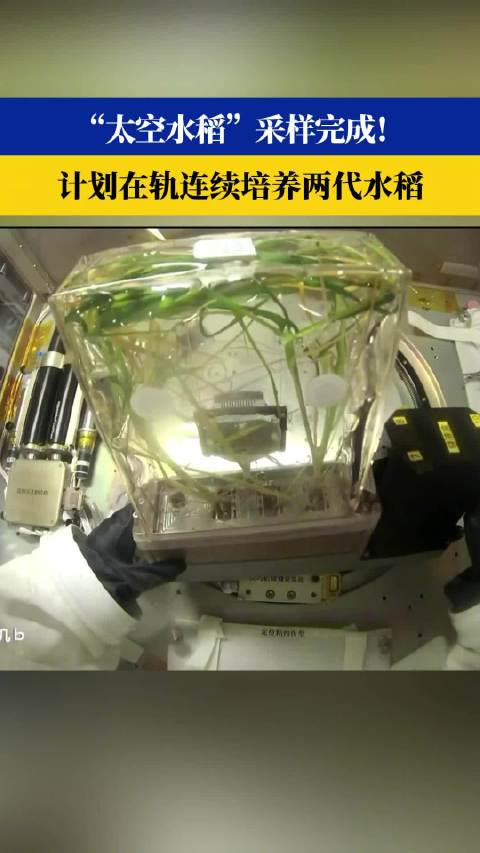
Space Rice Sampling Completed! Shenzhou-23 Crew Plans to Cultivate Two Generations of Rice in Orbit
Summary: On August 2, the China Manned Space Agency announced that the Shenzhou-23 crew completed the collection and storage of space rice experimental samples, aiming to achieve the worlds first continuous cultivation of two generations of rice in orbit.
According to an announcement by the China Manned Space Agency on August 2, the Shenzhou-23 astronaut crew successfully completed the collection and cryogenic storage of space rice experimental samples during their orbit. This experiment aims to study the effects of microgravity on the entire life cycle of rice, from seed to seed, providing critical data for food production during future long-duration space exploration.
The core objective of this experiment is to achieve the world's first continuous cultivation of two generations of rice in orbit. The crew will use the collected samples to continue cultivation within the space station's life and ecology experiment cabinet, observing and documenting the entire process of the first generation of rice growing, flowering, and producing seeds in the space environment. They plan to use the resulting seeds to initiate the cultivation of a second generation of rice in orbit. This marks a significant step for China's space life science research toward building a space ecosystem.
Previously, China's space station successfully completed the full life cycle cultivation experiment of rice from seed to seed, achieving a major breakthrough. The Shenzhou-23 crew's current task builds upon this foundation to verify whether rice can stably and continuously reproduce in microgravity, which is crucial for assessing the feasibility of future extraterrestrial agriculture. The relevant experimental data will be analyzed in depth by ground-based research teams.