
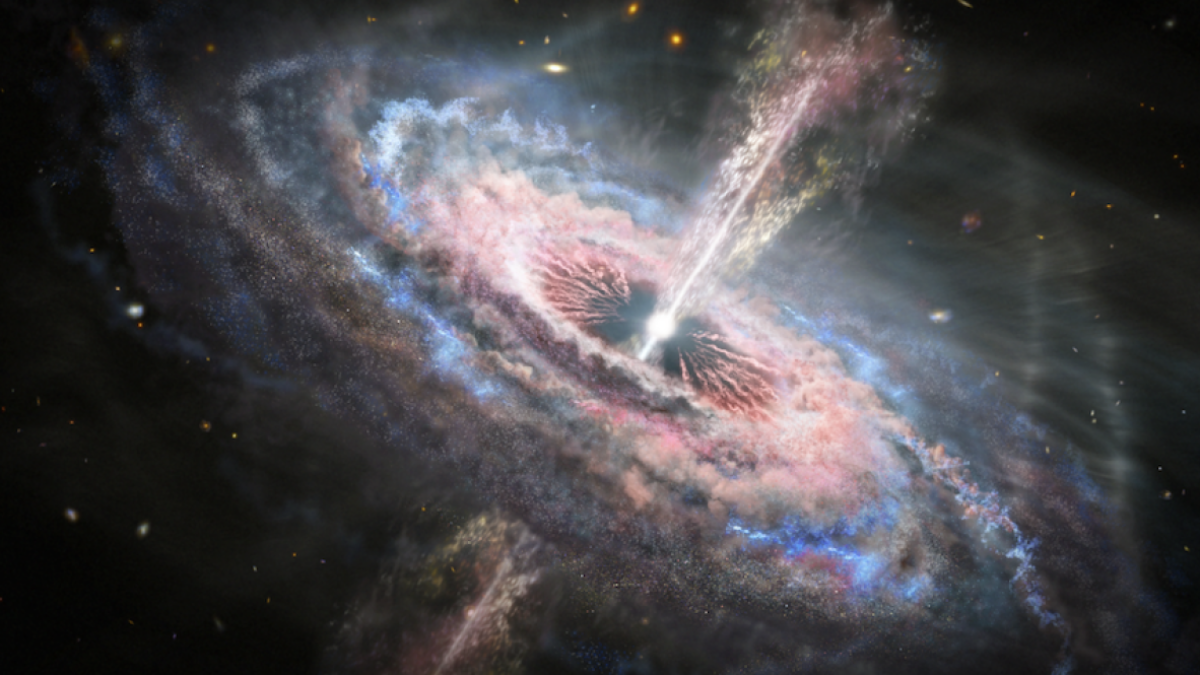
Webb telescope spots extremely bright quasars in cosmic voids
Summary: Using the Webb telescope to peer back into the earliest periods of the universe, researchers spotted some of the brightest objects in the cosmos — quasars — isolated in empty voids of space, away from typical galaxy environments.
The James Webb Space Telescope has revealed an unexpected finding: researchers have identified several unusually bright quasars residing in cosmic voids — vast, nearly empty regions of space with extremely low galaxy density. Quasars are among the most luminous objects in the universe, powered by supermassive black holes actively accreting surrounding material. Prevailing models have long held that quasars preferentially form in matter-rich environments where galaxy clusters provide ample gas and dust for black hole growth.
Leveraging its powerful infrared instruments, JWST peered back to the earliest epochs of the universe to make these observations. According to Mashable, the quasars found in voids are isolated from neighboring galaxies, far from the dense galactic environments typically associated with such objects. This is particularly puzzling because cosmic voids contain very little matter, making it difficult for conventional theory to explain how such luminous quasars could form and sustain themselves there.
The discovery poses a significant challenge to existing quasar formation models. If quasars can emerge and remain luminous in the sparse conditions of cosmic voids, it may suggest that early-universe black hole formation and growth pathways are more diverse than previously understood, or that void regions harbor matter distributions not yet fully characterized. Follow-up studies will analyze the spectral properties and host environments of these quasars in greater detail to clarify their origins. Specific data and methodology are expected to be confirmed upon formal publication.