
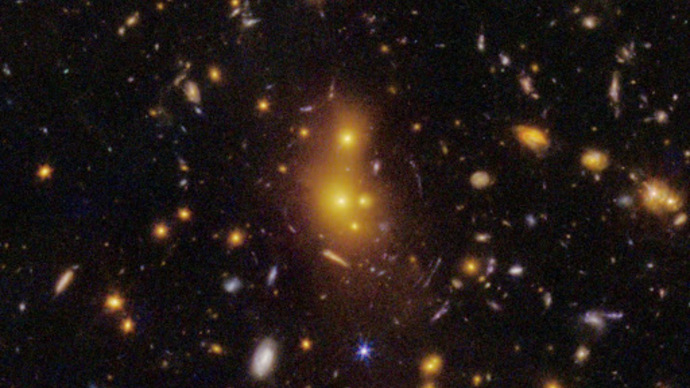
New JWST Images of Abnormally Well-Developed Galaxy Cluster Open Up the Cosmic Noon Frontier
Summary: New JWST observations presented at the 248th AAS meeting reveal an abnormally well-developed galaxy cluster from the Cosmic Noon era, reshaping understanding of early galaxy evolution.
New observations from NASA's James Webb Space Telescope (JWST), presented at the 248th American Astronomical Society (AAS) meeting in June 2026, have revealed a galaxy cluster from the early universe that is surprisingly well-developed for its age, challenging prevailing theories of cosmic evolution.
The so-called Cosmic Noon refers to the epoch when the universe was between roughly 2 and 4 billion years old (redshift z ~ 1–3) and star formation activity across the cosmos was at its peak. Conventional models predict that galaxy clusters at this stage should still be in relatively early assembly, with member galaxies not yet fully built up in mass and structure. JWST's deep infrared imaging of the cluster, however, shows that its member galaxies exhibit a level of maturity in mass and morphology that far exceeds theoretical expectations.
The IPAC/Caltech team noted that the cluster's anomalously mature characteristics imply that the timeline for galaxy cluster formation and growth may be earlier and faster than current models assume. This finding opens a new frontier for understanding galaxy assembly mechanisms during the Cosmic Noon era and raises questions that demand revisions to theoretical frameworks governing dark matter halo growth and galaxy merger rates.
The data and images have been made publicly available by IPAC. The research team plans to carry out follow-up JWST observations to confirm the cluster's physical properties and to search for similar structures in larger survey volumes, in order to assess how frequently such abnormally mature clusters appeared during Cosmic Noon.