
Black Hole Winds May Be Robbing Giant Galaxies of Raw Material for Stars
Summary: A study published June 18, 2026, using NASA/JAXA XRISM observations of NGC 4151, provides strong evidence that supermassive black hole winds blow away the raw gas needed for new star formation.
A study published on June 18, 2026, drew on data from the X-Ray Imaging and Spectroscopy Mission (XRISM), a joint NASA and JAXA satellite, to examine the Seyfert galaxy NGC 4151. Located roughly 62 million light-years away in the constellation Canes Venatici, NGC 4151 harbors a supermassive black hole at its center and has long served as a prime laboratory for studying black hole accretion processes.
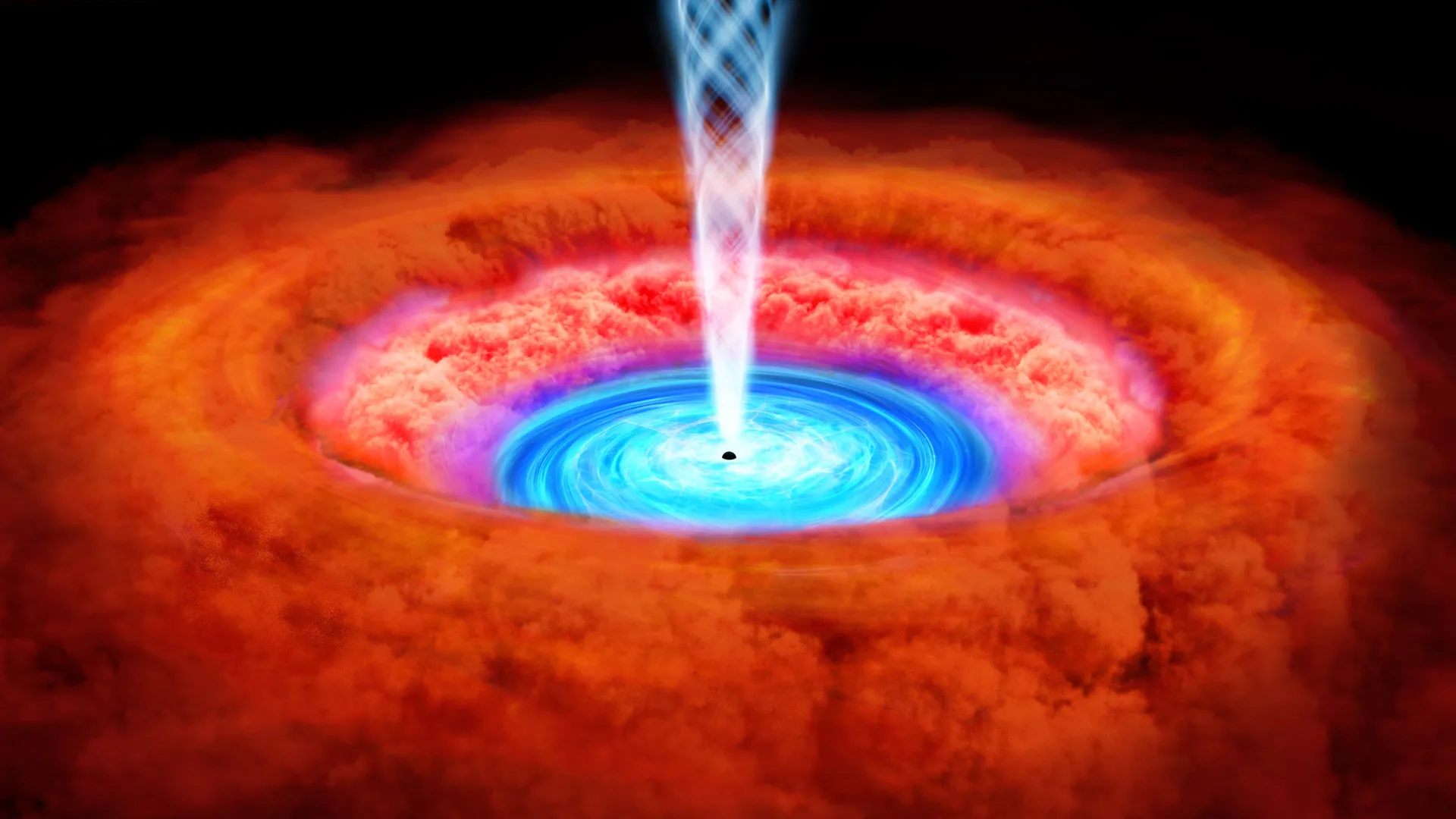
Using the Resolve microcalorimeter spectrometer aboard XRISM, the research team achieved high-resolution X-ray spectroscopy of the gas environment around NGC 4151's central black hole. They identified high-velocity outflows of gas emanating from the accretion disk — phenomena commonly referred to as black hole winds. These winds are capable of driving substantial amounts of cold gas out of the galactic disk. Because cold gas is the essential fuel for forming new stars, the outflows are effectively stripping the galaxy of its star-building raw material.
The findings provide direct observational evidence for the active galactic nucleus (AGN) feedback mechanism, a concept long theorized in astrophysics. Previous models predicted that radiation pressure and outflows from supermassive black holes could regulate star formation rates in their host galaxies, but precise measurements of the gas dynamics involved were lacking. The XRISM spectral data help fill that gap, clearly illustrating how black holes shape the evolutionary trajectory of their host galaxies through powerful winds.
The researchers noted that if this mechanism proves widespread among other massive galaxies, it could help explain why the largest galaxies in the universe often show remarkably low levels of star formation — the supermassive black holes at their centers may be sweeping away the very gas that new stars need to form. The result further underscores XRISM's unique capability for probing extreme astrophysical environments.