Ariane 6 Flies Four-Booster Configuration for First Time, Delivers Heaviest Ariane Payload Ever
Summary: On June 17, 2026, Arianespace launched Ariane 6 flight VA269 from Kourou, French Guiana, flying all four P160C solid boosters for the first time and deploying 36 Amazon Leo broadband satellites — the heaviest payload ever flown on an Ariane rocket.
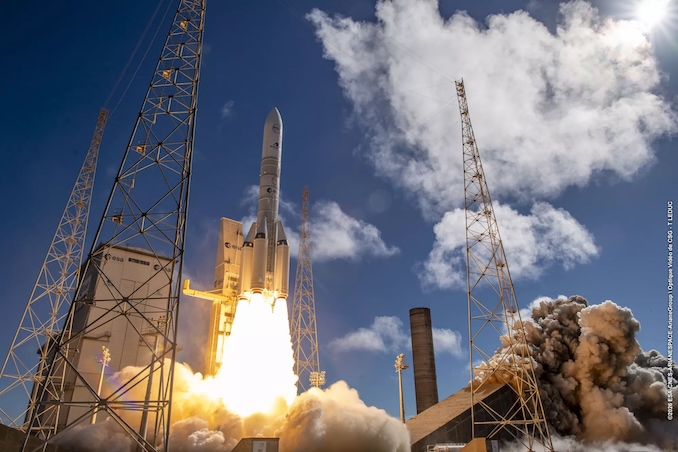
On June 17, 2026 local time, Arianespace lifted an Ariane 6 rocket off the pad at the Guiana Space Center in Kourou, French Guiana, on mission VA269. The flight marked the maiden use of the vehicle's full four-booster configuration — known in the industry as the 【Ariane 64】 variant — with four P160C solid rocket boosters strapped symmetrically to the core stage. It is the most capable configuration of the Ariane 6 family to date.
The payload consisted of 36 Amazon Leo broadband internet satellites, together setting a new record for the heaviest mass ever flown by an Ariane-family launcher. The 36 spacecraft arrived in Kourou on April 14 and 16 and were processed at the Guiana Space Center ahead of the launch. Ariane 6's core stage and the four P160C boosters had already been integrated on the launch pad before the mission.
Less than two and a half minutes after liftoff, the four P160C boosters separated sequentially from the core stage. Less than a minute later, the payload fairing was jettisoned. The cryogenic upper stage was then expected to perform a series of burns to deploy the satellites into their operational orbits. VA269 is the third Ariane 6 mission dedicated to the Amazon Leo constellation and the first to use the full four-booster configuration.