
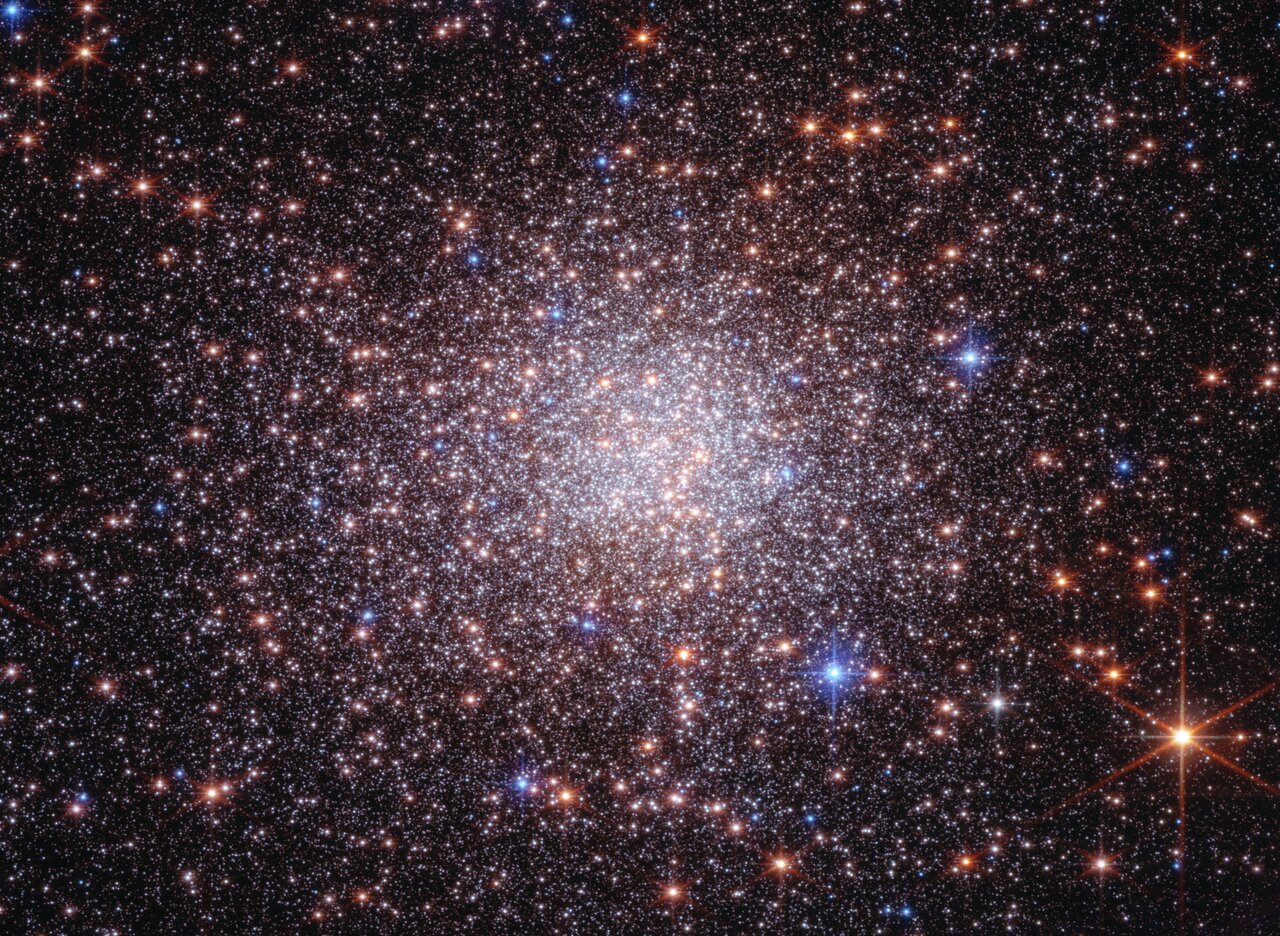
Webb and Hubble Reveal Milky Way Relic: Globular Cluster Terzan 5 Hosts Four Generations of Stars
Summary: On 16 June 2026 ESA/Webb released research confirming that globular cluster Terzan 5 contains four separate stellar generations, identifying it as a bulge fossil fragment of the Milky Way.
Globular cluster Terzan 5 sits in the central stellar bulge of the Milky Way. First catalogued by French astronomer Agop Terzan in 1968, it has long been one of the most heavily obscured globular clusters known, with thick foreground dust blocking most optical light. A press release issued jointly by the Space Telescope Science Institute (STScI) and NASA on 16 June 2026 reports that the combination of new Webb near-infrared observations with multiple archival Hubble datasets has now resolved the cluster into at least four distinct stellar populations, each with its own chemical-abundance signature.
The analysis shows that Terzan 5 is a self-contained, self-enriching stellar system. Successive generations of stars formed, evolved, and seeded later populations with heavier elements within the same compact region, leaving behind a layered chemical fingerprint. Similar signatures have previously been seen only in the surviving remnants of dwarf galaxies, suggesting a direct link to the way the Milky Way bulge was assembled through mergers and accretion in the early Galaxy.
On this basis the team formally classifies Terzan 5 as a bulge fossil fragment — the prototype of a newly recognised class of objects in the Milky Way. Researchers argue that the cluster preserves an intact record of the earliest stages of bulge formation, offering a rare fossil benchmark for reconstructing the Galaxy's early growth history. The full observational results are presented in the ESA/Webb press release weic2611, with the underlying journal paper details to be confirmed against the original publication.