
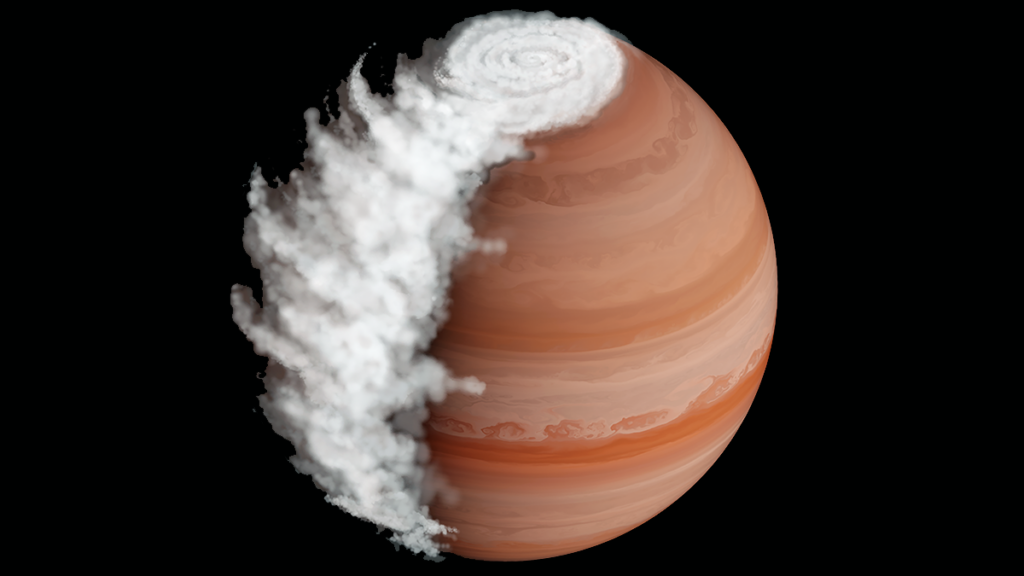
JWST reveals cloudy mornings and clear evenings on distant hot Jupiter WASP-94A b
Summary: On June 16, 2026, a Science paper used a novel JWST observation technique to characterize the day-night atmospheric cycle of hot Jupiter WASP-94A b, finding cloudy mornings and clear evenings.
A new study published in Science has turned the James Webb Space Telescope toward a hot Jupiter — WASP-94A b — with the goal of separating atmospheric signals from different longitudes within a single transit spectrum. WASP-94A b orbits its host star on a short period and is tidally locked, so one hemisphere faces permanent daylight and the other permanent night; consequently, the longitudinal sequence sampled during a transit maps onto different phases of the planet's day–night cycle. The team, according to the report, applied a novel JWST observation technique designed to recover this spatially-resolved information from the transit light curve.
The headline result is a clear dawn-to-dusk contrast: cloudy in the morning, clear in the evening. This kind of morning-evening asymmetry is consistent with the broad picture of hot-Jupiter atmospheric circulation, in which morning-side updrafts favor condensation and evening-side downdrafts — combined with intense afternoon irradiation — push cloud cover to the dawn limb. What the new result reportedly adds is the first direct detection of this morning/evening contrast on WASP-94A b, anchoring the three-dimensional structure of its atmosphere to a specific observable.
WASP-94A b belongs to the family of short-period hot Jupiters, and its host system also includes a stellar companion, WASP-94B, which gives the planet a relatively well-characterized environment to work in. According to the report, the new observation technique isolates the small transit-spectral differences produced by atmospheric inhomogeneities, marking a methodological step forward for JWST-era exoplanet atmospheric characterization. The specific instrument configuration and quantitative details should be confirmed against the original paper.