
Artemis II Science Underway as Orion Begins Return Trip to Earth
Summary: The Artemis II Orion spacecraft "Integrity" has entered its return leg after completing a historic lunar flyby. The four crew members captured more than 175 GB of images during the April 6 flyby, with about 50 GB already returned via an experimental laser communications payload — including 20 GB transmitted in just over 45 minutes. NASA says all lunar science data will be publicly released within six months of splashdown. Splashdown is scheduled for 8:07 PM EDT on April 10, off the coast of San Diego, California.
 Credit: NASA
Return Journey and Science Data
On April 6, Reid Wiseman, Victor Glover, Christina Koch, and Jeremy Hansen became the first people in more than half a century to fly around the Moon. After the flyby, the spacecraft executed a 15-second reaction control system thruster burn, adjusting velocity by about 0.5 meters per second to begin the return trajectory.
Science team lead Kelsey Young said at a press briefing that among the thousands of images already returned, "every single image has something that surprises me." In addition to high-resolution photographs, the crew recorded hours of voice narration documenting their real-time observations of the lunar surface.
Laser Communications Breakthrough
The experimental laser communications payload aboard Orion demonstrated remarkable potential: it successfully returned 20 GB of data in just over 45 minutes — orders of magnitude faster than the traditional S-band telemetry system. About 50 GB of data had been returned to the ground as of the briefing.
Toilet Issue Update
The previously reported Orion spacecraft toilet malfunction — a partially blocked wastewater vent line — remains ongoing. Engineers have ruled out ice buildup and now suspect chemistry or biofilm debris clogging a filter. The issue does not affect mission safety.
Splashdown and Data Release Timeline
- Splashdown time: April 10, 8:07 PM EDT
- Splashdown location: Off the coast of San Diego, California
- Science reports: Two reports to be released within six months of splashdown — one on the science team's structure and operations, and a preliminary lunar science report addressing 10 pre-mission science objectives
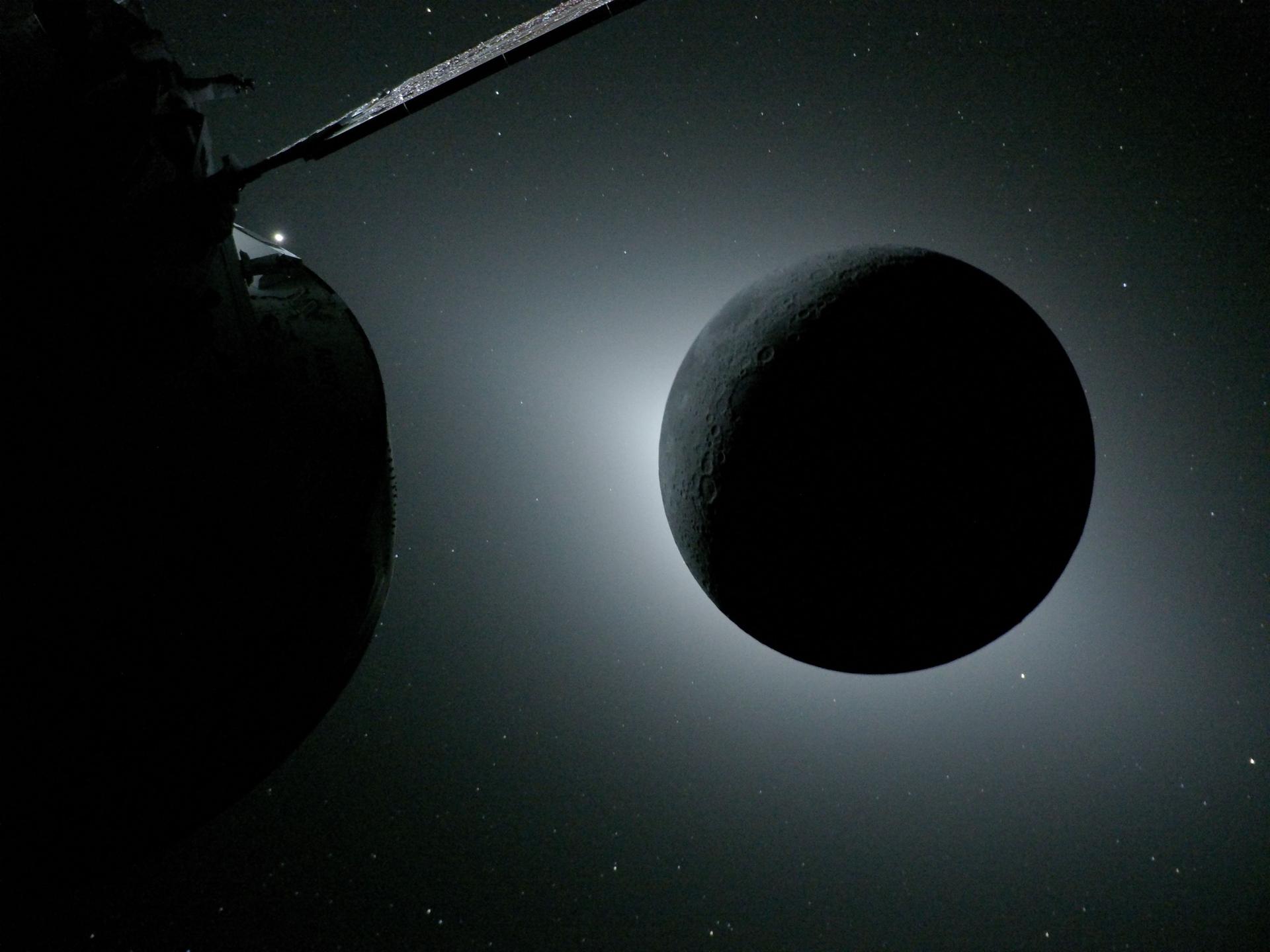 Solar eclipse as seen from the Orion spacecraft during the lunar flyby. Credit: NASA