Chinese Startup Sustain Space Validates Flexible Robotic Arm On-Orbit, Advancing Servicing Capabilities
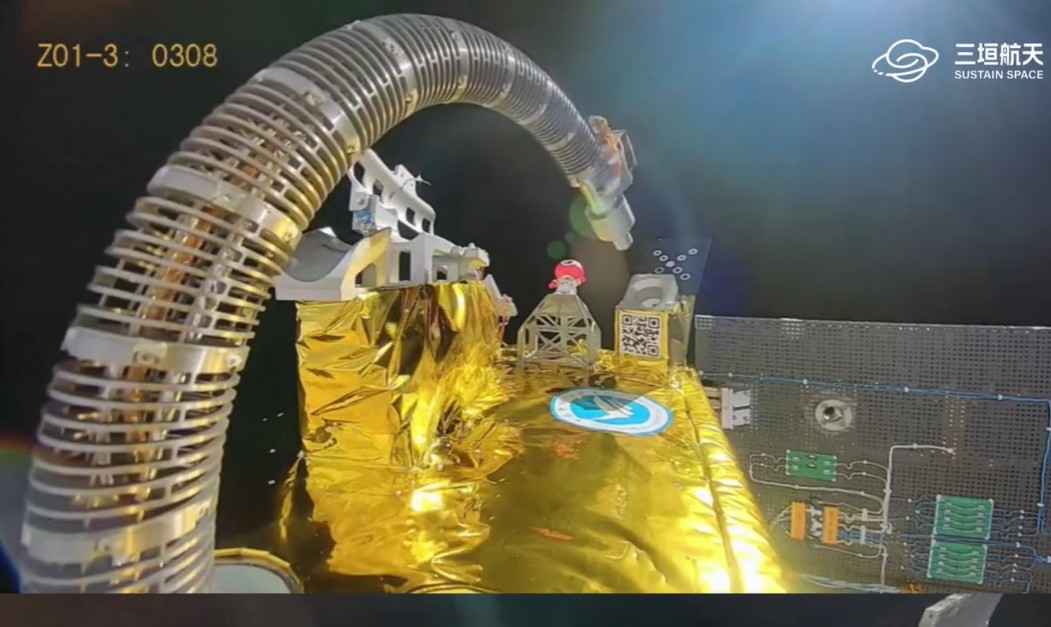
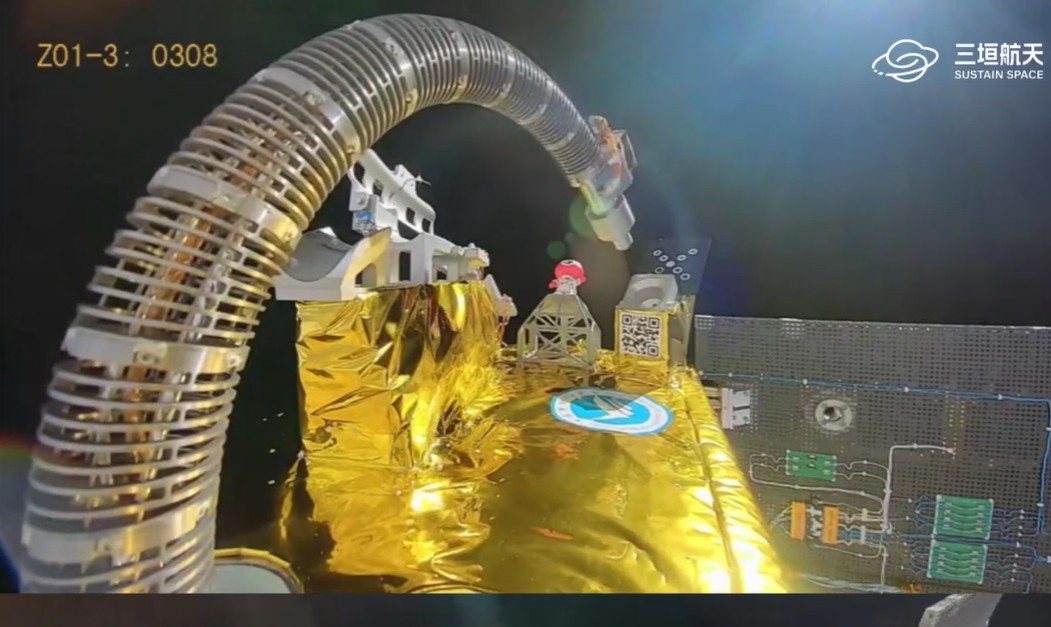
Summary: Chinese commercial space company Sustain Space (Sanyuan Aerospace) successfully completed on-orbit demonstrations of a flexible robotic arm aboard its Xiyuan-0 satellite. Launched March 16 on a Kuaizhou-11 rocket, the satellite tested simulated refueling operations, force-compliant manipulation, and precision control. On March 25, the company announced all on-orbit operations were successfully completed, with all four operation modes verified.
Credit: Sustain Space
Mission Overview
Sustain Space's Xiyuan-0 satellite (also known as Yuxing-3 (06)) was launched aboard a Kuaizhou-11 rocket on March 16 (UTC). The satellite features a flexible robotic arm designed to test simulated refueling operations, force-compliant manipulation, and precision control.
According to a March 25 statement from Sustain Space, all on-orbit operations of the flexible robotic arm have been successfully completed, marking what the company describes as a step forward for China's commercial space industry in on-orbit space services.
Four Operation Modes Verified
Sustain Space successfully verified four operation modes:
- Pre-programmed autonomous refueling simulation: The robotic arm autonomously executed simulated satellite refueling operations
- Human teleoperation: Ground operators remotely controlled the arm's movements in real time
- Vision-based servo operations: Precision positioning and manipulation based on optical feedback
- Force-controlled drawing tests: Verifying the arm's force-sensing and force-control capabilities
Industry-Academic Partners
Development of the satellite involved multiple partners demonstrating industrial-academic cooperation:
- Shenzhen Mofang Satellite Technology Co., Ltd.: Satellite platform provider
- Tsinghua University Shenzhen International Graduate School: Co-developer of the robotic arm
- Hunan University of Science and Technology: Optical payload for vision-based control and teleoperation feedback
- Emposat: Communications and operations support
On-Orbit Servicing Prospects
The tests mark progress toward on-orbit servicing capabilities including satellite life extension, in-space assembly, and debris mitigation. The reported refueling activities were simulations, with no actual propellant transfer confirmed.
In addition to the robotic arm tests, the Xiyuan-0 satellite will conduct an accelerated deorbit experiment using a deployable drag-augmentation sphere, demonstrating a potential method for reducing orbital lifetime and mitigating space debris.
Global Context
On-orbit servicing is a hot area in the global space industry:
- China's Shijian-21 and Shijian-25 spacecraft appear to have completed pioneering on-orbit refueling tests in GEO in 2025
- U.S. companies like Astroscale and Northrop Grumman are pursuing similar capabilities using different technical approaches
- NASA cancelled its OSAM-1 project in 2024 due to delays and cost overruns, though the agency continues to support in-space servicing technology development